Showing posts with label Buddhism. Show all posts

Tuesday, August 14, 2018

Book I Read: Journey Out of Nothing


I picked up this book and finished reading it overnight. Having live in a Buddhist country for 12 years, this book is informative and helpful. Although, this is about Zen Buddhism instead of Theravada, the basic tenets are the same.

While in his twenties and thirties, international journalist and best-selling author Martin Roth, living in Japan, became deeply involved in Zen Buddhism. So much so that he co-authored a reference work on the subject, “Zen Guide.”

Now he explains the attraction of Buddhism to himself and to other young Westerners. He also recounts – often in amusing detail - some of his adventures.

He became possibly the first Westerner to complete a famous pilgrimage to thirty-three temples in northern Japan. On another pilgrimage he spent three days hiking through some of Japan’s holiest mountains, sometimes standing under frigid waterfalls in purification rituals. He stayed at famous monasteries, often participating in morning worship services full of dazzling ceremonies.

He introduces some of the fascinating people he met. These include the young priest who lived and meditated in a giant soy sauce barrel; the professor who devised “commuting Zen” meditation for his strap-hanging one-and-a-half-hour rail commute to work each day; and the American advertising executive who became head of his own Japanese Zen temple, a place where Caroline Kennedy, now US ambassador to Japan, stayed during her honeymoon.
But he also explains why his interest in Buddhism began to fade, and why, today, he is a Christian.

This short book (18,000 words), part travel adventure, part memoir, part spiritual odyssey, will entertain and inform.

Contents:
Introduction
Chapter One – First Steps
Chapter Two – Learning about Buddhism
Chapter Three – A Series of Newspaper Columns
Chapter Four – Writing a Book
Chapter Five – Zen Adventures
Chapter Six – Was I a Buddhist?
Chapter Seven – Kyoto
Chapter Eight – Heading North
Chapter Nine – Christian Zen
Chapter Ten – Buddhist Art
Chapter Eleven – Doubts
Chapter Twelve – Becoming a Christian
Chapter Thirteen – Buddhism and the Book of Ecclesiastes
Chapter Fourteen – Talking with Buddhists

Wednesday, November 29, 2006

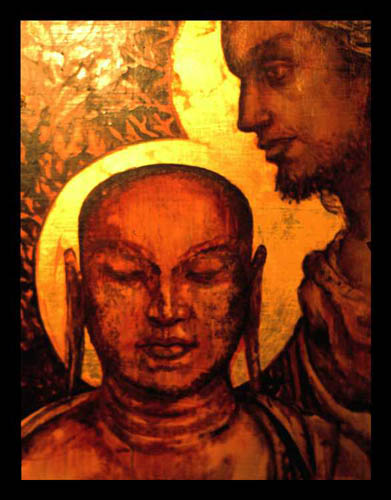
The Christ and the Buddha

Christians living in a predominant Buddhist country struggle on how they can speak about their faith that makes sense to their neighbors. On the surface, it seems that Buddhism and Christianity have very little in common. We have no choice but to begin on a common pointm, start from the subject you know they are famiilar with. Although sometimes, it will surprise you that they know little about the philosophy or theory of their religion. It is because their religion is not much of a matter of sophisticated theology that drives them to their religious practices. Even Buddhist thinkers would reject the rituals and some bizarre practices of a folk Buddhists but the folks do it anyway because they think that is what their religion demands from them and it makes them feel better.

My point here is it is good to teach them about their own belief and start a conversation. It is important to understand religious experiences express in the practices and learn as much as possible the theory behind the practice. This is the same with Christianity. There are underlying theories in our every religious experience and practice. It is sad enough that many Christians really do not understand the theory or the theology behind our practices such as worship, communion, baptism among others. Nonetheless, I appreciate evangelical Christianity emphasis on teaching and learning as part of being a church member. At least, through this we understand our doctrines that somehow explain some of our practice.

Dialogue between Christianity and Buddhist is possible only if at least one of the dialogue partners have knowledge of both faiths. And I believe the burden of learning other religion is on our shoulders to make our faith understandable. I admit, this is not easy but only through such interweaving of theory and practice, experience and reflection, will be able to put the dialogue between Buddhists and Christians about the message of the Buddha and the message of Christ. Hopefully, there are more similarities than differences.

Hans Kung names some of the similarities of the two religions. I have to depend on secondary sources by Hermann Haring on his book about Hans Kung because I don't have a copy of Kung's Christianity and the World Religions (I hope I can buy a copy in the future). Nevertheless, here Kung points out the similarity between the Christ and the Buddha. Both Christ and Buddha appear as teachers, proclaim good news, want to liberate human beings from their desires and their self-centeredness and point out a middle way, of selflessness, of concern for fellow men and women. That makes the difference all the more significant. Jesus was not solitary, but a master in an alternate community; no break can be established in hi life. The differences can be clarified most plainly by means of the distinction between a prophetic and mystical spirit.

The Buddha Gautama is a harmoniously self-contained peaceful, enlightened guide, inspired by the mystical spirit. Sent by no one, he demands renunciation of the will to life for the sake of redemption from suffering in nirvana. He calls for turning inwards, away from the world inward, for methodical meditation through the stage of absorption, and so finally to enlightenment. Thus he shows calm fellow feeling, with no personal involvement, for every sentient creature, man or animal; a universal sympathy and peaceful benevolence.

Jesus Christ, however, is a passionately involved emissary and guide, inspired by the prophetic spirit and, for many, even his own lifetime, the Anointed One (“Messiah”,”Christ”). He calls men and women to conversion for the sake of redemption from guilt and all evil in the kingdom of God. Instead of demanding a renunciation of the will, he appeals directly to the human will, which he bids orientate itself on God's will, itself aimed entirely at the comprehensive welfare, the salvation, of humankind. Thus he proclaims a personally concerned love, which includes all the suffering, the oppressed, the sick, the guilty and even opponents and enemies: a universal love and active charity.

These are some of the similarities. Other such commonalities and differences as well will be dealt with in the future posts.

About the image: The image is taken from MattStone Blog
created by Ruth Jones.

Saturday, November 11, 2006

The Christian problem of God in its encounter with Buddhism


Our internet service provider had been down for a while. So I missed reading my favorite blogs for days. Anyways, it's getting colder here everyday. But I enjoyed the coolness of the night, sipping coffee while having a theological conversation with my Burmese Pastor. We talked a lot about the problem of the different tribal churches here and the difficulties of communicating the gospel to the Buddhists both in Thailand and Myanmar. It dawned on me that my knowledge about a Buddhist's perception of the world and of the deity is so little. I still have to learn a lot. If I want to make the gospel clear to them I have to know how their minds works. My Pastor is trying to help by presenting me theological papers written by his professor in the seminary. As he knows I am running blog, he ask me if I can post it here. And I gladly oblige.

The following thoughts are from his good professor a Burmese theologian named Professor U Khin Maun Din. This section deals with the problem of Burmese Christians Theology with its encounter with Theravada Buddhism. This part deals with the conflicts on the concept of God between Christianity and Buddhism. The next post will deal with the problem of Christology.

Buddhism is considered to be an atheistic religion or at best a non-theistic faith by many Christian theologians and religious philosophers. It is because Buddhism denies the existence of God as personal being or a creator. This personalistic idea of God is rejected by the Buddha because it could not explain the vexing problem of evil. But the Buddha does not deny the existence of what can be philosophically described as “the Transcendence” or “the Ultimate Reality.” If affirmation of the existence of a Transcendental Reality is what we meant by theism, then Buddhism is profoundly theistic. This raises a big problem for traditional Christian theology that insists that God is to be understood as Personal Being. However, process theologians’ understanding of God as becoming rather than being. Here process theologians give way to a more living, dynamic and changing conception of God rather than the traditional view of God as complete, perfect and static. Some of them agree with Paul Tillich in describing God as “the Ground of our Being.” This impersonal representation of God is considered by its critics as closer to Buddhism than Christianity. However, this paved the way to the possibility that the Christian idea of God can be made understandable for Buddhism and other Asian transcendental religions.

However, in the view of the Theravada Buddhists these understanding of the deity are still relative ways of understanding the Transcendence. For Buddhists the best way to describe the Ultimate Reality is not to describe it all because the Absolute can never be described by relative human terms. This theology is not peculiar to Buddhism alone. The Taoists of ancient China also held a similar view of Reality. They say that “the Tao is the name of the nameless one.”

The point here is: can we as Christians insist to speak about God as a person or a personal being in an absolute sense. Is it not closer to the truth to speak of God as a person as well as not-a-person; that God is a Being as well as a Becoming, that God exists and also does not exist?

This way of understanding the theos has been referred as the “the Yin-Yang way of Thinking.” It is the Both/And method of doing theology and being advocated by Asian theologians to be more progressive as opposed to Either/Or method used by classical Christian theology in formulating theology. The Either/Or way of thinking in the West not only promoted but shaped the absolute dogma of God. The God of dogma is not God at all. The God who is absolutized by human words is less than God of Christianity.

From such perspective the “silence” of the Buddha becomes pregnant with meaning. To the Buddha the relatively best way of describing the true nature of the Transcendence is not to describe it at all. This methodology can be discern as common in major oriental philosophies like Taoism of ancient China, the Jains of India among others. The oriental refusal to predicate the Transcendence with the western philosophical categories should be interpreted as the denial of the “existence” of “God” as a “Personal Being or “a Creator” is not a total rejection of the indescribable, transcendental theos.

What can we learn from this Oriental Methodology should Christian theology continue to keep on referring to God as a person in an absolute sense? Is it against the Bible to speak of God is a Person, as well as-not-a Person, that God is a Father as well as not-a-Father, that God is a Creator as well as not a Creator, that God is a Thou as well as not a Thou?

How must we interpret God’s answer to Moses: “I am that I am?” Is the word “I” to be understood as referring to a Self, a Soul, an Ego, an Atman, a Spirit or even a Geist as used by Hegel? If that scripture text means: “I will be to you what I will be to you,” as it is not interpreted today, then is it not the case that the answer is to be understood functionally and not ontologically? If that is the case, then metaphysically speaking, such an oriental way of understanding the Theos can be more comprehensive and sometimes even more faithful to the Gospel than most dogmas attached to the traditional Christian doctrine of God.

I can understand the difficulty of Christians in Burma to conceive God in non-personal terms. We are being so metaphysically conditioned by the traditional theology that the very idea of a non-personal God becomes totally incomprehensible to us. But this means that we must also be sympathetic to the Buddhists for whom the very idea of God as Personal Being is incomprehensible. If Christian theology in Burma and in Thailand still persists in speaking of God only and absolutely as a Person then the Christian God will be reduced to the level of a Nat or a Brahma.