Showing posts with label Bible Study. Show all posts

Wednesday, January 06, 2021

We owe to others what God did to us

Matthew 6:14-15 

For if you forgive other people when they sin against you, your heavenly Father will also forgive you. But if you do not forgive others their sins, your Father will not forgive your sins. 

Christians should act toward others the same way God acted toward us. God is generous, faithful, and gracious. We can not help but treat others with these attitudes.

God forgives us so we should forgive others. He blesses us so that we can enrich others, and sets us free so that we can serve others. Having received so much from God, we can give to others out of the gratitude of our hearts.*

 “When God was merciful to us, we learned to be merciful with our brethren. When we received forgiveness instead of judgment, we, too, were made ready to forgive our brethren. What God did to us, we then owed to others.” - Dietrich Bonhoeffer, Life Together 

Prayer

Lord, having received from You, help us to bless others with Your blessing. Amen.

*Charles R. Ringma, Seize the Day with Dietrich Bonhoeffer

Thursday, June 18, 2020

That Time Will Come


Mark 13:32-33

“But about that day or hour no one knows, not even the angels in Heaven, nor the Son, but only the Father. Be on guard! Be alert. You do not know when that time will come.”

Coronavirus disease (COVID-19) has infected more than 8 million people worldwide since November. World Health Organization (WHO) declared it a global pandemic. Together with other events like the worldwide riots because of racism, and recent developments in technologies like chip implants, 5G networks among others.

Many conspiracy theorists and Christian groups flood social media about the end of the world, the emergence of the antichrist, and the eventual second coming. Christians need to understand that these theories are not relevant in our belief that Jesus will come again soon. With or without these events, sooner or later, He will come again in God’s perfect timing.

The Bible has a different concept of time than us. We are concerned with the “passage of time,” in Hebrew there is no word for the chronological time. Instead, the emphasis is on "providence” of timing or the “purpose” of a certain time.

This is especially clear when we listen to the words of Jesus Himself. They are all be found in the New Testament. He often used words such as “day”, “age”, “generation”, “hour.” He spoke of “my hour has not yet come”, “the signs of the time”, “no one knows the time”.

But on every occasion, Jesus’s reference to time has to do with something significant or the importance of a specific event. Jesus is never concerned with controlling the time or getting more of it. He is only concerned with aligning with His Father’s perfect timing.

In the verse, Jesus tells us that no one knows the time. As Christians, we need to think differently about the time of His coming. Here are several things we can do.

Be prepared—we need to be alert and ready to present ourselves to God

Be patient—we need to trust that God’s timing is perfect in all matters

Be priority-driven—We need to pursue all accomplishments great and small with the sole purpose of knowing God, loving God, and displaying God’s glory.

One Minute Reflection

Do your activities show that you are ready for the Second Coming?

“Bible teaching about the Second Coming of Christ was thought of as ‘doomsday’ preaching. But not anymore. It is the only ray of hope that shines as an ever brightening beam in a darkening world.” – Billy Graham

Tuesday, May 19, 2020

Proven character

Romans 5:5

“We also glory in tribulations, knowing that tribulation produces perseverance; and perseverance, character; and character, hope.”

How do we develop a Christlike character?

Character is the springboard to a successful life. Developing a godly character in the face of our daily struggles is essential to having a more intimate relationship with Christ. Character is not just having integrity or being honest or even doing the right thing. A person’s character is the sum of his or her disposition, thoughts, intentions, desires, and actions. It is good to remember that character is developed over many experiences, not based on a few isolated actions.

Romans 5:5 says that our character develops from experiences of conflicts and tribulations. God uses trying times for our ultimate good.

Moreover, we are reminded in the Scripture that we can rejoice in trials because trials produce perseverance and perseverance produce Christ-like character and Christ-like character is a proven character, which leads to eternal hope.

Proven character comes from the word “dokime” in Greek. It is used to describe metals that had been tested and determined to be pure. The idea behind is that when metal is put through a fiery test and it comes out on the other side “persevering and enduring,” that metal is now proven to be genuine or authentic.

The same process happens when our faith is tested. If we persevere and hold up under the heavy load of difficult circumstances, we have “proven” that our faith and character are genuine and authentic.

One Minute Reflection

What tribulation God uses that shows your real character?

“The measure of every man’s virtue is best revealed in time of adversity—adversity that does not weaken a man but rather shows what he is.” – Thomas Kempis

Excerpt from Tracy Fox, Having A Heart For God Devotional: 365 Days of the One Minute Bible Study.

Thursday, May 07, 2020

Meeting Our Needs


Philippians 4:19

“And my God will meet all your needs according to the riches of His glory in Christ Jesus.”

The Bible reveals God as our provider. Throughout the pages of Scripture, God is portrayed as the one who sees and cares for all of our needs.

Today we are examining the wisdom we can extract from Paul's New Testament letter to the church in Philippi, which was founded around 50 AD. Paul is sharing four important truths about having our needs met by Christ, Himself.

What can we learn from Philippians 4:19?

One

Paul uses the words “my God.” We can take comfort in the fact that God knows us intimately and deeply and is our personal provider.

Two

Paul tells us, “my God shall supply.” If we seek God, we can allow Him to supply whatever we need.

Three

Paul reports that God shall meet “all your needs.” This is where we have to separate out our desires from our needs. God will give us what we need to develop into the persons He originally created us to be.

Four

Finally, Paul asserts that God meets our needs “according to the riches of His glory in Christ Jesus.” God's giving is not merely giving from His riches, but according to His riches. In other words, Christ, Himself, is the prize, not what we can gain from Him. It is a critical distinction.

One Minute Reflection

What do you need out of God's riches today?

After the Lord has tried our faith, he, in the love of His heart, gives us an abundance. For the glory of His name and for trial of our faith, He allows us to be poor and then graciously supplies our needs.”- George Muller

True Humility


James 4:10

“Humble yourself in the sight of the Lord and He will lift you up.”

James made it clear that God will lift up those who live a humble life that honor Him.

What is true humility?

It means seeing God as the gracious giver of everything and seeing ourselves as sinful and needy in His presence.

Ultimately we need to get the focus off our own abilities and trust totally in God, so that He gets all the glory and our own light is merely a reflection of all He has done.

How do we keep our humility in check?

  1. Routinely confess our sin to God
  2. Always keep God's Grace in view
  3. Remember that all we have comes from God
  4. Invite God to search and expose places where pride has taken root
  5. Get on our knees as an act of humility before God in prayer

True humility is a place where our pride is abandoned and our hope is lifted.

It is when we admit our need and claim our dependence upon Almighty God.

One Minute Reflection

What area of your life could you demonstrate more humility?

The true way to be humble, is not to stoop until you are smaller than yourself, but to stand at your real height against some higher nature. – Philip Brooks

Excerpt from Tracy Fox, Having A Heart For God Devotional: 365 of the One Minute Bible Study

Friday, May 01, 2020

What Are You Thinking?


Proverbs 23:7 

“For as He thinks in His heart, so is He."  

Many philosophers take this idea but God said it first in the book of Proverbs. We are what we think.

What we think, is what we become.

The happiest and most fulfilled people are those who focus on the Word of God and His promises. They are intentional about maintaining joy and gratitude to honor God with their lives. We can have the same experience. If we want to be happy and joyful, we must affirm all the good and it becomes part of our nature to emit joy.

Here Are Some Suggestions For A Happy and Successful Mindset

  1. Start your day with Scripture: "This is the day the Lord hath made - let me rejoice and be glad it in" (Psalm 118:24)
  2. Do not speak negative words about other people, situations, or feelings
  3. Thank God for everything in your life - both the good and the bad.  Then remind yourself that God has a better plan in mind when we place our trust in Him
  4. Expect only the best and then go get it
  5. Be careful what you think about: As Philippians 4:8 reminds us, "Finally, brethren, whatsoever things are true, whatsoever things are honorable, whatsoever things are just, whatsoever things are pure, whatsoever things are lovely, whatsoever things are of good report; if there be any virtue, and if there be any praise, think on these things."

One Minute Reflection
What do you think about all day long?

"Whether you think you can, or you think you can't, you are always right."  (Henry Ford) 

Excerpt from Fox, Tracy. Having A Heart For God Devotional: 365 Days of the One Minute Bible Study (Kindle Locations 474-503).

Wednesday, April 22, 2020

Discipline of Prayer


1 John 5:14-15 
 “And this is the confidence which we have before Him, that, if we ask anything according to His will, He hears us. And if we know that He hears us in whatever we ask, we know that we have the requests which we have asked from Him.” 
Prayer is a discipline that completely transforms our lives!

Why?
The more we understand the heart of God, the more we are taught to see things from God's point of view and not just our own. 
 
When we plug back into our Creator, He gives us the answers we seek.

Christianity's heroes of the faith have viewed prayer as the most important activity of their lives.  Jesus, Moses, David and the Apostles invested a regular part of their day in prayer.  Other great inspirational leaders such as Martin Luther, John Wesley, Charles Stanley, and Billy Graham - all have proclaimed the discipline of prayer as the most important of spiritual disciplines.

Prayer is something we learn and cultivate over time.  The more time we spend in prayer, the better we get at it.  The Bible teaches that prayer makes a difference in the events and situations of our lives.

Prayer is so important that it is mentioned over 250 times in Scripture.

In 1 John 5 above we are reminded of several things:
Prayer gives us an opportunity to share all aspects of our lives with God
Prayer gives us the chance to express our gratitude for the things God provides
Prayer provides the platform for confessing our sin and asking for help 
 Prayer is an act of worship to acknowledge that God is really in control of our lives
During prayer, we find communion with God

One Minute Reflection
How much more time could you dedicate to prayer this week?
"Fight all your battles on your knees."(Charles Stanley) 
Excerpt and adopted from Tracy Fox, Having A Heart for God: 365 Days of One Minute Bible Study. 

Tuesday, April 21, 2020

Audience Of One


Matthew 6:1

“Be careful not to practice your righteousness in front of others to be seen by them. If you do, you will have no reward from your Father in Heaven.”

Most of us, whether we are aware of it or not, do things to please an audience. This has become increasingly true in our modern, publicity-seeking, popularity-concerned, reality-television, social media based society.

The question is not whether we have an audience but which audience we have.

As followers of Jesus Christ, we should only be concerned with God being our number one fan. When we take this pursuit seriously almost all of our endeavors are transformed.

God has designed each of His commands for our benefit: to protect us from harm and help us develop a foundational contentment, regardless of circumstance.

Jesus makes it very clear in our passage today that we are not to practice our righteousness in front of others because if we do, we will receive no reward from our Father in Heaven. When we live only for God’s praise, we realize that His commands are actually blessings in disguise.

If we want to create a tangible difference in our own call as Christians, we need to grow in our awareness that only one opinion ultimately matters.

Our desire should be to please God alone.

One Minute Reflection
What audience do you care about and why?

“I have only one audience. Before you, I have nothing to prove, nothing to gain, nothing to lose.” [Winston Churchill]

Tracy Baumer Fox, Having A Heart For God Devotional: 365 Days of the One Minute Bible Study

Thursday, April 09, 2020

Selah Amid COVID-19


The COVID-19 pandemic helps us realize that we are a community. We are not meant to live as an individual in our private world. Somehow, somewhere each one of us has a connection. Every action we do affects someone, in our country, in our town, in our community, our neighborhood, and our family.

The question we need to ask is after this pandemic is: “Will we ever be the same?” I hope our answer is: “No, we will never be the same. The worst that could happen is to go back to the way we were before. We must not stay the same. We must never be the same again.”

The sons of Korah wrote this song during a time of chaos, trouble, and uncertainty. This Psalm was written for the nation of Israel, but it applies to us today too. Reading this Psalm, we will notice the word “Selah” mentioned repeatedly in verses 3, 7, and 11.

The word “Selah” is a direct transliteration from the Hebrew. Psalms are songs meant to be sung. “Selah” refers to a musical rest. The singers stopped singing to take a breath. It also means a silent reflection.

Moreover, “Selah” can also be translated “to praise” and “to lift.” Perhaps the singers paused so they could think about what they had just sung in praise to God. It is something required for the singers to do. So “Selah” means that we should pause and praise God. Every time we see “Selah” while reading Psalm we pause, look up, and praise God.

1 God is our refuge and strength, an ever-present help in trouble. 2 Therefore we will not fear, though the earth give way and the mountains fall into the heart of the sea, 3 though its waters roar and foam and the mountains quake with their surging. (Selah) 4 There is a river whose streams make glad the city of God, the holy place where the Most High dwells. 5 God is within her, she will not fall; God will help her at break of day. 6 Nations are in uproar, kingdoms fall;he lifts his voice, the earth melts.7 The LORD Almighty is with us; the God of Jacob is our fortress.(Selah) 8 Come and see what the LORD has done, the desolations he has brought on the earth. 9 He makes wars cease to the ends of the earth. He breaks the bow and shatters the spear;he burns the shields with fire. 10 He says, “Be still, and know that I am God; I will be exalted among the nations, I will be exalted in the earth.” 11 The LORD Almighty is with us; the God of Jacob is our fortress. (Selah)

So while reading this Psalm, we can pause, look up, and praise God for:

His Promise: God Is For Us (1-3)

1 God is our refuge and strength, an ever-present help in trouble. 2 Therefore we will not fear, though the earth give way and the mountains fall into the heart of the sea, 3 though its waters roar and foam and the mountains quake with their surging. (Selah)

The word used here for God is “Elohim” which means that He is the Creator, King, Judge, and Savior. Regardless of what we are feeling in this troubled time. This is a reminder to us of God’s promises that He is our refuge, our strength, and our help. He is not asking us to go to a safe place. But He (himself) is our place of safety. The word “refuge” is a place of trust and literally, it means “to flee” running into an indestructible shelter.

God promised us that He will hide us in His shelter, and His strength will help us. He is a “very present help in trouble.” The word “very” means His help is great and abundant right now in our present situation. God’s help exceeds any kind of help that any humans can do. We should be glad that we are serving a God who is always ready to help when we are in trouble.

In verse 2, the writer imagines the worst calamity that may happen to us. Earthquakes, volcanic eruptions, and mountains slipping into the sea. It seems like the destruction of the planet earth. But even though the earth gives way” or the landscape suddenly changes, we don’t have to be afraid.

Verse 3 describes the roaring waters of the sea. This represents something so violent that we have no total control. Roaring means “to rage” or “to be at war.” COVID-19 is not as violent but it is a crisis that we don’t have total control. Every country is in a commotion on what to do next. Humanity’s sense of control has been replaced with fear and concern about the future. It’s fair to say that the entire world has been humbled by this pandemic.

This Psalm tells us that when our security is suddenly gone, we’re to seek refuge in God. Our sense of helplessness and fear should draw us nearer to God. We will echo the voices of many people of God that this tragedy should bring us to our knees and cause us to be a more humble world.

God says in 2 Chronicles 7:14. “If my people who are called by my name humble themselves, and pray and seek my face and turn from their wicked ways, then I will hear from heaven and will forgive their sin and heal their land.”

This pandemic is pointing us to the real problem—humanity’s pride, self-centeredness and spiritual brokenness.

His Presence: God Is With Us (4-7)

4 There is a river whose streams make glad the city of God, the holy place where the Most High dwells. 5 God is within her, she will not fall; God will help her at break of day.6 Nations are in uproar, kingdoms fall;he lifts his voice, the earth melts. 7 The LORD Almighty is with us;the God of Jacob is our fortress. (Selah)

God promises us shelter when we need it. We don’t have to look for Him because His presence is with us. In verse 4 the city of God refers to Jerusalem. It was a beautiful city but we all know that there is no river flowing through it like any other major cities during that time like Babylon has Euphrates, Egypt has Nile, Rome has Tiber. Jerusalem has not the physical river, but it had something even better—the presence of God.

The word “Most High” is Elyon, which refers to God as the highest of all. He is sovereign and supreme, and He is present with us. God’s grace flows like a river to bring gladness and joy to His people. While the ocean rages, God’s presence is depicted as a calm and gently flowing stream. This image in the Scripture is used to represent happiness, abundance, and peace, even when everything else is falling apart.

God’s presence with His people is one of the central truths of Scripture. Verse 5 says that “God is in the midst of her” and verse 7 declares that the “Lord of Hosts is with us.” This is from the root word “Immanuel,” which means “God with us” and was used in Matthew 1:23 to refer to Jesus. This means when we put our faith in Jesus, we have “God with us” at all times.

Notice the last part of verse 5: “God will help her at the break of day.” No matter how bad things get, God’s presence means He will help us. When we wake up to start a new day, we will experience what Jeremiah did in Lamentations 3:22-23: “Because of the Lord’s great love we are not consumed, for His compassions never fail. They are new every morning; great is your faithfulness.” God is faithful to us. He will never leave us or forsake us.

His Power: God Is Over Us (8-11)

8 Come and see what the LORD has done, the desolations he has brought on the earth. 9 He makes wars cease to the ends of the earth. He breaks the bow and shatters the spear; he burns the shields with fire. 10 He says, “Be still, and know that I am God; I will be exalted among the nations, I will be exalted in the earth.” 11 The LORD Almighty is with us;
the God of Jacob is our fortress. (Selah)

We can depend on God during times like this because of His promise, His presence, and finally, because of His power. Verse 8 says that God calls us to “come and see what the LORD has done.” The word “come” means “we are to run or pursue” in order “to see” or “to behold.”

It means “to perceive through sight, to gaze intently upon, to observe fully.” It expresses a strong feeling of hope, expectation, and certainty. “To behold” has the idea of vividness and emotional involvement. Here we are commanded, “to come and behold.”

There is a phrase that says, “We become what we behold.” A Pastor tells it like this: “Tell me what you are beholding, and I’ll tell you what you are becoming.”  When we behold the Lord and His works, we become like Him and do His works. I believe in this COVID-19 pandemic many people are seeking the Lord right now.

Verse 9 shows us that in His position as the Almighty God, He makes “wars cease to the ends of the earth; He breaks the bow and shatters the spear, He burns the chariots with fire.” We believe that the LORD has the power to stop the war.

Sometimes we feel like that there is nothing we can do to stop COVID-19. We may even feel helpless and even hopeless. This pandemic helps us realize that we don’t have control over the details of our lives. But God is in total control.

In verse 10, we are called to “be still and know that I am God.” To “be still” means to “cast down or let fall” and was used to the idea of dropping weapons. We have to stop fighting a battle we can’t win.  We are not to just have a “moment of silence” or even to just be quiet. We are to cease, surrender to God, and let go.

The purpose of being still is so that we can know God. To “know” means “to acknowledge and comprehend, to discover intimately.” It is not just enough just to know about Him; we must have a deep personal relationship with Him. To do that, we need to be still before Him, pray and listen to His words.

The last part of verse 10 says that “I will be exalted among the nations, I will be exalted in the earth!” Ultimately, all nations will exalt God. Jesus will come again and all the nations will surrender before Him. No matter what happens, in this pandemic: God will be exalted among the nations and He will be exalted in the earth. He is working out all things for His glory and our ultimate good.

Verse 11 is a great summary statement of this entire psalm as it repeats verse 7. Because “the Lord of hosts is with us, and the God of Jacob is our fortress,” we can trust Him.

Conclusion

Jesus Christ is God and Lord of history. Nothing has happened outside of His plan. Through worst disaster, though the mountains fall into the sea, if we believe in Jesus we have nothing to fear.  Whether COVID-19 pandemic leads to more catastrophe and confusion, or the nations rage against one another, God is our refuge.

No matter what happens, we can pause, look up and praise Him for His promise, His presence, and His power.

Let’s pause here at the final “Selah” and praise God for His power. It’s time to be still and surrender before Him because we know that He is the most powerful God.

Photo is from South China Morning Post
Adopted from Pastor Brian Bill’s Sermon

Wednesday, March 25, 2020

If the Lord's will


James 4:13-17


We are now living amid COVID-19 crisis. Our President declared a nationwide lockdown to stop the rapid spread of the coronavirus. It is important to follow the government during this troubled time. I understand that we should be together for prayer and worship. But wisdom declares that we should stay at home and not to gather. We want to stop the virus from moving around. If people keep moving around, we are making a way the virus spread rapidly more than our healthcare professionals and front-liners can handle.

It is in time like this that we also the best and worst among us. I believe that people are good, God created us in His own image anyway. Sin may have marred God's image in us but it still there. However, in a situation like this, sin also exposed the worst among us. Our self-centeredness.
We are going to see from our text that self-centeredness sickness infected even Christians. We can read it in James 4:13-17. We will learn that the cure for self-centered sickness is following the will of God.
“Come now, you who say, ‘Today or tomorrow we will go into such and such a town and spend a year there and trade and make a profit’— yet you do not know what tomorrow will bring. What is your life? For you are a mist that appears for a little time and then vanishes. Instead, you ought to say, ‘If the Lord wills, we will live and do this or that.’ As it is, you boast in your arrogance. All such boasting is evil. So, whoever knows the right thing to do and fails to do it, for him it is sin.”
Verse 13 gives us the symptoms of our disease: “Come now, you who say, ‘Today or tomorrow we will go into such and such a town and spend a year there and trade and make a profit.’” People, even Christians make plans without any regard for God’s will.

The statement “come now,” is found only in this verse. It is a forceful warning to businesspeople. In James’ day, sellers would buy goods from one city and travel to a distant city and remain there until they sold those goods at a profit. Then with the profit, they will buy goods from that city and move to another city to sell the goods.

These business people had a good business plan. They had everything figured out or so they thought. They answered all the questions:
  • When? “Today or tomorrow”
  • Where? “such and such a town”
  • How long? “spend a year”
  • What? “trade”
  • Why? “make a profit”
It was a good plan, but they forget the most important question—who? God was not included in the plan. Having a plan is good but planning without acknowledging God is.

Making plans is a good thing but planning without acknowledging God is selfishness and arrogance. Acknowledging God’s will over our lives is a cure for our self-centeredness sickness.

Admit we do not know the future (14)

Listen to the first part of verse 14: “Yet you do not know what tomorrow will bring.” We don’t know what will happen tonight, much less next week or next year. Proverbs 27:1: “Do not boast about tomorrow, for you do not know what a day may bring”. The COVID-19 pandemic proves this point. The only time we know for sure is this time, right now.

Yesterday is called “the past” because it has already passed. Tomorrow is yet to come. To be honest, we will not know what will happen tomorrow. That is why, a quotation says: Yesterday is history, tomorrow is a mystery, and today is a gift—that is why it is called the present”.

The rich fool made plans he thought would give him security for the rest of his life. He planned for what he knew would happen, but according to Luke 12:20, he was caught unprepared, “God said to him, ‘Fool!’ This night your soul is required of you, and the things you have prepared, whose will they be?’”

We don’t know our future; our future is in God’s hands alone. Unless we commit ourselves and our plans to God, our future is meaningless.

Acknowledge the brevity of life (14)

Life is not only uncertain; it’s also short. We see this in verse 14: “What is your life? For you are a mist that appears for a little time and then vanishes.” J. B. Philips version says it this way: “You are like a puff of smoke visible for a little while and dissolving into thin air.”

The Greek for “mist” is atmos, from which we get the word “atmosphere.” James is thinking of the morning mist which appears for a “little time” and goes away when the sun comes up. The word “vanishes” has the idea of utterly disappearing.

Have you ever thought of yourself as fragile as the mist? You’re here one moment and then gone the next. Even if you live to be 100, time goes by quickly and like vanishing steam from a hot cup of coffee, you will eventually evaporate from the earth.

Brothers and sisters, life is too uncertain and too short to live it without God at the center. We count our lives in years, but God tells us in Psalm 90:12 to number our days. Everyone in this room is just one heartbeat away from eternity.

Because life is short, live as if this is the last day of your life. Have you admitted ignorance about the future? Have you acknowledged the brevity of life?

Align with God’s will (15)

The third directive is found in verse 15: “Instead you ought to say, ‘If the Lord wills, we will live and do this or that.’” We’re called to move from arrogant independence to dependence upon God. God is actively and personally involved with His people. Because He has plans and purposes for us, we must seek Him and His will. The little word “if” makes all the difference. “If” the Lord wills, we will live and do this or that.

No amount of money, influence, power, or planning can guarantee tomorrow. Only God can grant us another sunrise or another breath. Let’s declare with David in Psalm 31:15: “My times are in your hand.”  It would be helpful for us to say, “Lord willing” whenever we make plans. The key is not to make this phrase a trite formula but to really mean, “If the Lord wills.”

One commentator offers this helpful insight:
  • We should refer to God’s will.
  • We should defer to God’s will.
  • We should prefer God’s will.
It’s not wrong to make plans, but we must make sure they align with God’s purposes. Proverbs 19:21: “Many are the plans in the mind of a man, but it is the purpose of the Lord that will stand.”

Avoid arrogance (16)

According to verse 16, God does what He chooses in my life. Therefore, I must accept what He chooses to do: “As it is, you boast in your arrogance. All such boasting is evil.” The word “boast” means to exult oneself higher than God.

If we plan without aligning ourselves with God’s purposes, we become arrogant. 1 Corinthians 5:6: “Your boasting is not good…” We might call ourselves Christ-followers but by leaving God out of our lives, we are acting like atheists. Boasting is evil because we are defying the true state of our lives and living like we don’t need God for anything.
I appreciate Charles Spurgeon’s advice for conquering pride:
  • Embrace your Nothingness – “Be not proud of race, face, place, or grace.”
  • Embrace Christ – “Pride cannot live beneath the cross.”
  • Embrace Suffering – “The benefit of the furnace; it melts, tries, and purifies.”

Act in obedience (17)

We’ve been challenged by the Book of James to live out what we’re learning. The final directive is found in verse 17: “So whoever knows the right thing to do and fails to do it, for him it is sin.” This literally reads, “sin it is to him.” This attitude says something like this, “God, I know what you want me to do, but I’m not going to do it. I know better than you do.”

Some of us think we haven’t done anything bad, so we’re good to go. Perhaps we even point out others who’ve done awful things. But the truth is we can sin by doing nothing. It was Edmund Burke who said, “All that is necessary for evil to triumph is for good men to do nothing”.

James is addressing the sins of omission, which result from failing to do something God’s Word commands us to do. A sin of commission is a sin we actively commit.

The best way to deal with the future is to be faithful today. Now is always the right time to act because it is the only time you can be sure of it. The only moment you can guarantee is this moment. When you procrastinate doing the right thing, you end up doing the wrong thing.

We could say it like this: Delayed obedience is disobedience. Do you have any delayed obedience in your life? Do you know what God wants you to do or to stop doing, but you’ve been delaying?

Conclusion

We are living in uncertain and dangerous times. Nobody knows what will happen in the future. There is a quote that says: “We do not know what the future holds but we know who holds the future”. The safest place in the world is if we are in the will of God. We do it by admitting that we don’t know what will happen in the future, acknowledge that life is short, align our will with God’s will and we should act in obedience.

Sunday, November 01, 2015

If You Love The Lord

iSight-2015-11-1-13-11.png
Let those who love the Lord hate evil, for he guards the lives of his faithful ones and delivers them from the hand of the wicked. Light shines on the righteous and joy on the upright in heart. Rejoice in the Lord, you who are righteous, and praise his holy name.-Psalma 97:10-12

This morning, I want to ask you a question. Do you love God? If so, how much? And do you ever say to God, “I love you”? When we love God, he loves us back more. The truth is God loves us first, otherwise, we would not know what love is.

The Bible says in I John 4:10 10: This is love: not that we loved God, but that he loved us and sent his Son as an atoning sacrifice for our sins.

Let those who love the Lord hate evil. Why should we love God and hate evil at the same time? Because the two are completely opposed to each other! There is good in the world and there is evil. God is good and even beyond good. He is love. And He hates evil and if He hates evil He also wants us to hate evil.

I heard it said a long time ago that if we have no hatred for evil then how can we love that which is good? So it seems reasonable that if we love God who is totally good then we will also hate that which is evil.

This morning, we will learn what will happen to us if we love the Lord. What we will enjoy if we truly love God.

God Will Guard Our Lives (v. 10)

10 Let those who love the Lord hate evil, for he guards the lives of his faithful ones and delivers them from the hand of the wicked.

This verse clearly says that God will protect our lives. Because God saves us he will keep us safe. Those who love the Lord will have the assurance that God will protect us from evil and the enemy could not hurt us.

He will not only keep us safe but he will save us from the hand of Satan and will keep us by His side until we enjoy his presence when we die or when Jesus comes again.

A little boy was afraid of the dark. One night his mother told him to go out and bring her the broom. The little boy turned to his mother and said, "Mama, I don't want to go out there. It's dark." The mother smiled reassuringly at her son. "You don't have to be afraid of the dark," she explained. "Jesus is out there. He'll look after you and protect you."

The little boy looked at his mother real hard and asked, "Are you sure he's out there?" "Yes, I'm sure. He is everywhere, and he is always ready to help you when you need him," she said. The little boy thought about that for a minute and then went to the back door and cracked it a little. Peering out into the darkness, he called, "Jesus? If you're out there, would you please hand me the broom?”

Are you or were you ever afraid of the dark? Or something in the dark? Call on Jesus! It’s always smart to call on the Lord no matter what you fear or whatever you need in life. Are you afraid to go to far places to share Jesus? Don’t be afraid because God promise that he will always be with you. Are we afraid to stand up here and proclaim how Jesus saves us? Pray to the Lord and God will be the one who will speak for you.

God Will Make Our Light Shine Brighter (v. 11)

11 Light shines on the righteous and joy on the upright in heart.

Would you agree that we are living in a very dark world? The Bible makes it clear that the world is full of darkness. Our world is full of corruptions, sin and selfishness. People are thinking only about themselves. Satan knows that if he can give people material things, they will be under his power. WE are living in a very dark world.

But Jesus is the light of the world and if we believe in him, we became his light. But if we love the Lord, he makes our lights shine brighter.

Have you ever went inside the Tham Luang Cave? Three years ago, we went inside the big cave. If you are inside the cave and you don’t have light, the cave was totally dark. You cannot see anything. So sometimes I wonder if you go deep inside the cave and lost your light. I imagine you can get lost and maybe you may not find your way out. It is so scary.

It is so depressing to live in darkness. We are living in a dark world. If you watch the news on TV you see more corruptions, crimes, shootings, rapes and murders. But the good news is it only need a small light to make this dark world becomes light. If only each of us will love God more, we can make this word, our community where we live in a brighter place.

God Will Bring Joy to Our Hearts (v. 11b-12)

….and joy on the upright in heart. 12 Rejoice in the Lord, you who are righteous, and praise his holy name.

If we love God we will have joy in our hearts. We find joy in the Lord and in our relationship with Him. This joy last forever and will not end in the passing of time. To many people, being happy is a matter of what is happening. So if good things happen they are happy, and good things do not happen, they are not happy. That is the way of the world.

Many of us who are older realise that lasting joy is not happiness based on what is happening in our lives. Most of the time, money, new car, new house, new phones, new gadgets make us happy. The Bible says that material things will not make us happy forever. It is only temporary. There is only one way we can have joy in this life forever, and that is through having Jesus Christ in our lives.

Dr. James Dobson of the Focus on the Family Ministry says, “Although I am not rich, I have tasted most of the things people want for. I had new cars, beautiful home, gadgets, devices which promise to set us free. But the truth is they can not give us satisfaction. On the contrary, I found out that the things you own will eventually own you.”

I agree and I look at people today buying a lot of things that they think can make them happy and will give them joy. But they become a slave of the things they bought. We spend so much time making our house beautiful, repairing our car, using our phones instead of spending time with our families and spending time with the Lord and his Word.

Conclusion

There is one way we can be assured of God’s protection, shining our light and have a lasting joy and happiness in this world. That is through believing in Jesus Christ and to love him with all our heart, all our mind, all our strength, all our soul.

Wednesday, September 24, 2014

Our Part in a Miracle

John 6:1-13 Feeding to 5000

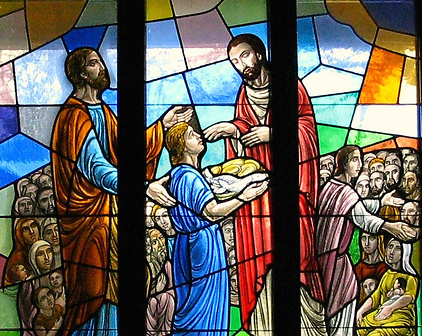
What is your favourite miracles of Jesus? For me it is the feeding of the 5,000. Many people think and agree that if you assume that each man may have brought their wives and at least two children with them, the number of people may have been like 15,000. The people witnessed how Jesus performed miracles and people are excited to follow him everywhere he goes. Jesus wanted to get away from the crowd cross the river by boat with his disciples hoping that the people would stop following him and he would have time alone with the disciples. But the people would not give up, seeing that Jesus and his disciples rode the boat, the people started running along the shore through a rough woods and headed where the boat was going.

So when Jesus saw arrived some of the people were already there and had looked for a place to settle down. Instead of getting angry with the crowd, the Lord Jesus had compassion to the people and do something to take care of their needs. In this story, we will learn how the Lord Jesus did a miracle and we will learn what did the people do to experience that miracle in their lives.

Jesus wants our participation (5-6)


5.When Jesus looked up and saw a great crowd coming toward him, he said to Philip, "Where shall we buy bread for these people to eat?" 6. He asked this only to test him, for he already had in mind what he was going to do.
These verses clearly say that Jesus did not have to ask this question because “he already know what he was going to do.” He asked the question to test the faith of Philip and in effect the other disciples too. The Lord Jesus Christ does need anybody to tell him what to do. The only reason he asked this question is to know what the disciples are thinking and he wants them to share their thoughts and ideas. Jesus want his disciples to participate in helping to resolve the problem at the moment. 

Apparently, Philip is very smart because after looking at the crowd he knows right away how much money they need to feed all the people. He comes up with 200 denarii. In present times it is roughly equivalent to 4,000 US dollars or roughly 124,000 baht. And would not be enough to buy a bread enough that each person to get a little piece. Andrew, on the other hand, share his idea by getting Jesus’ attention that there is a little boy who is willing to share his food—five small loaf of bread and two small fish. He thinks it is impossible to feed all the people with this amount of food. I believe the important truth here is not only Jesus tests the disciples but also he wanted them to share ideas, do something to help with the problem. Jesus wants everyone to participate.

How do you eat an elephant? One bite at a time. We all know the saying, but we often fail to apply this lesson in our lives. If you view the elephant as one big goal that your whole life depends on, you’re setting yourself up for disappointment. Why not enjoy the bites along the way? If you ask somebody what goal they’re working on, what kind of answer do you think you’ll get? Assuming they even have goals, they’ll probably say they’re working on something really big, maybe even something that will make them feel like they’ve achieved their life purpose.1 Our church have big vision and big goal. We want to share Jesus Christ to many people as possible. We envision that our church will grow big and have many people come to worship our God. This goal is big. It is like an elephant. We can not eat it. It seems impossible. But if everyone of us will cooperate and will take a little bite one at a time. 

We will eventually accomplished the goal that God has set before us. The problem is only very few in the church like to cooperate. This is God’s challenge for us this morning. All of us should cooperate to accomplish our goal as a church.

Jesus Wants Our Contribution (6-9)

Another of his disciples, Andrew, Simon Peter's brother, spoke up, "Here is a boy with five small barley loaves and two small fish, but how far will they go among so many?"
In verse 6, it says that Andrew speaks up and says, "Here is a boy with five small barley loaves and two small fish, but how far will they go among so many?" Some Bible teachers think that this little boy is employed by the disciple to carry their food. But I believe, this little boy has committed himself to following Jesus wherever he goes that he make sure that he is totally prepared. 

The other people who follow Jesus and even the disciples never bother to bring their own food. I want you to take note the way John describes the situation. Here is a “little” boy with five “small” barley loaves and two “small” fish. I believe John is trying to show the greatness of our God that a miracle has come out using these small things. But, of course, these small things from little boy are what all Jesus need. He never asks us to have more education, more talent and more money in order to serve him and minister to others. All he wants is what we have right now. And as soon as he found out what is available in the crowd, Jesus performs a wonderful miracle. 

 There was a story of a little girl who stood outside the church crying. She could not get into the church to attend the Sunday School because the church was too small and there was no space for her. So the Pastor saw him and took her hand and found a place for her in the Sunday School class. The girl was so touched that night she went to bed praying and thinking of the children who have no place to worship. The Pastor told her that someday they would have a building big enough so that all the children can worship and attend Sunday School. Later the girl got sick and died. They found out that the little girl has a purse that contain 57 cents with a note saying that she was saving the money to help build a bigger church building. The 57 cents became the seed money that inspired many people to contribute to the fund that eventually built a 3,300 seating capacity of Temple Baptist Church in Philadelphia, USA. This story is being told to show what God can do with 57 cents. This is what God wants us to do, everyone can bring something to God. He teaches us that it is not the gift that is so important, it is the heart of the giver. 

In our church, people contribute different things. We need people who will be prayer warriors. We need musicians and singers to lead in worship. We need workers to clean and set up our church. Some contribute money, some contribute things that we can use in the church. If everyone of us will contribute to the ministry of the church, the Lord will do miracles in our church.

Jesus Wants Our Cooperation (10-13)

Jesus said, "Have the people sit down." There was plenty of grass in that place, and they sat down (about five thousand men were there). Jesus then took the loaves, gave thanks, and distributed to those who were seated as much as they wanted. He did the same with the fish. When they had all had enough to eat, he said to his disciples, "Gather the pieces that are left over. Let nothing be wasted." So they gathered them and filled twelve baskets with the pieces of the five barley loaves left over by those who had eaten. (John 6:10-13)
When Jesus learns that little food is available, he asked the disciples to make the people sit down. Just imagine 15,000 hungry people want to eat and food was so little, it is surprising that everyone including the children are cooperating with Jesus. We read how orderly and organise was the event in Mark 6: 39-44:
39 Then Jesus directed them to have all the people sit down in groups on the green grass. 40 So they sat down in groups of hundreds and fifties. 41 Taking the five loaves and the two fish and looking up to heaven, he gave thanks and broke the loaves. Then he gave them to his disciples to distribute to the people. He also divided the two fish among them all. 42 They all ate and were satisfied, 43 and the disciples picked up twelve basketfuls of broken pieces of bread and fish. 44 The number of the men who had eaten was five thousand.
In this passage we learn how every one including the children cooperate with the process. John MacArthur: "Godly, Biblical church growth results from every member of the body fully using his spiritual gift, in submission to the Holy Spirit and in cooperation with other believers.” When each one of us is willing to cooperate with the church’s ministry and activities, cooperate with our leaders and with each other, the Lord Jesus will perform a miracle though us and through our church.


Conclusion

Imagine yourself asking someone to be part of our church. “Do you want to be part of our church?” And imagine that the person will answer like this: “I want a church will accept me as I am.” “I want a church that will care for me.” “I want a church that where my needs are met.” “I want a church that makes me feel happy.” “I want a church that will feed me spiritually and make me grow.” We can answer that is our church… provided (if) that: “If you and other church members will accept others as they are.” “If you and other church members will care for one another.” “If you and other church members will make others feel happy.” “If you and other church members will feed and make help each other grow spiritually.” Miracles happen or at least great things happen when the people of God all participate, contribute and cooperate in what God desires to do through his people.

Friday, March 16, 2012

Real Faith (James 2:14-26)

fake-iphone.jpg

Introduction
Everybody who comes to Thailand will notice the presence of  fake products. Thailand is one of the  countries in the world that  allows fake products. It never stop to amaze me how imitations look like the real deal. There are fakes of everything. Fake Ipad, Iphone, shirts, shoes. There are even fake watches and pens. Sometimes, I even think there are fake churches and even fake Christians.

This is what James talks about in this passage. He argues about the case of true faith against fake faith. There are a lot of people who think they are have real faith, they think that they are Christians. We may not be aware of it, but we may our faith may not be real.

In the verses, James discusses the difference between having real faith and having false faith in Christ. The Bible tells us what it means to have real faith. Let’s go ahead now and focus in on the book of James. Let’s look at five facts about faith:

Real Faith is Works It is Not Just About Talking (2:14)
What does it profit, my brethren, if someone says he has faith but does not have works? Can faith save him?” James 2:14 (NKJV) Real faith is all about works while fake faith is all about talk.

In this verse, it does not say that a person has faith. The verse talks about claiming he has faith. A person who says he has faith can talk about faith very impressively. In other words, he may know to use the right words, the right sentences. He may know the Bible and perhaps discussed about Christian doctrines. But it does not prove that he has faith.

In our situation here in Thailand, where Christians are a minority, we tend to easily call people Christians. If they talk about Christianity, and claim to be Christian or sound like a believer we right away call them Christian.

However, we know better than that, for the Bible says that:

"Not everyone who says to Me, ’Lord, Lord,’ shall enter the kingdom of heaven.” Matthew 7:21 (NKJV)

Not everyone who has fish on their truck is a believer. Not every who wears a Christian T-shirt knows Christ as their savior. Not everyone who sings Christian song is a Christian. Not everyone who profess Christ does not mean he possess Christ.

As the saying goes, "talk is cheap." If we say we have accepted Christ as our savior but there are no changes in our lives. There are no evidences that Christ lives in us. We need to be seriously concerned. Real faith is not just something we talk about. It is not about what we say. It is something you live. It involves your life not just your lifestyle.

Real Faith Acts It Is Not Just About Feeling (2:15-16)
Real faith is more than emotions. Many Christians confuse emotional high with the work of the Holy Spirit. Although, we believe that when the Holy Spirit is working we all get excited. But being emotionally hight does not necessarily mean that the Holy Spirit is working.

We can go to the church, sing loudly, shout amen, pray at the top of our voices but it may not mean that it is the work of God. The Bible tells us that real faith is more than the way we feel. James gives us the practical advice:

"If a brother or sister is naked and destitute of daily food, and one of you says to them, "Depart in peace, be warmed and filled," but you do not give them the things which are needed for the body, what does it profit?” James 2:15-16 (NKJV)

We are part of this church. God put us here for a purpose. I think one of the reasons is that there are many people in this church and around us that have needs. Many of us feel about the situation that our brother and sister in Christ are in, but if we do nothing, what good does it do? Real faith takes the initiative and does anything within our capacity to help. A real believer has a faith that is practical. It gets involved with people. When we become part of God's family, we have family responsibilities. Real believers care about real people.

First John chapter three verse seventeen tells us:

“If you see some brother or sister in need and have the means to do something about it but turn a cold shoulder and do nothing, what happens to God’s love? It disappears. And you made it disappear.”
1 John 3:17 (MSG)

Real faith gives. Real faith is generous. Real faith can be counted on in a crisis. Real faith is not just talking the talk – it’s walking the walk. Faith is more than feeling sorry for someone – it’s doing something about it.

Real Faith Shows It is Not Just About Thinking (2:18)
For some people faith is something to think about. A matter to be studied, debated and discussed about. James understand this when he says:

“But someone will say, "You have faith, and I have works." Show me your faith without your works, and I will show you my faith by my works.” James 2:18 (NKJV)

To understand this verse, we need to imagine two people get together. The one says, "I have faith." The other says, "I have faith too." Then they argue who has the real faith. Then the other says, "show me your faith." I bet he could not show it. The other guy says, "I show you my faith, you can see it through the works I do."

Underline the words "show me." James is saying, you cannot show your faith without works. Faith without works is fake. It is only through works that we can show faith. Real faith is to be seen in our actions. The evidence of faith is works. We can prove our faith to anybody by those who has affected by the things I do for Christ.

If you think you have real faith. If you claim to be a real Christian, people will see it. Real faith is visible. James says that – “I will show you I have faith – by what I do!”

“Faith without works is dead.” James 2:17 (BBE)

Faith in Christ - changes things. If you have faith – it is active – it does something. Faith is not just a though process – it causes action. But that’s not all:

Real Faith Commits Not Just About Believing (James 2:19)
Look at what James chapter two verse nineteen tells us:

“You believe that there is one God. You do well. Even the demons believe--and tremble!” James 2:19 (NKJV)

Believing in God does not make us a Christian. There are many people who believe in God and some of them can even quote the some verses. They can even recite the Lord's Prayer by memory. They can even talk about doctrine. Sounds good. But James says even the devil can do th same. He believes.

Real faith involves committing yourself completely to Christ. We are Christian because we believe and trust in Jesus. It is more than head knowledge. It's heart knowledge. We understand that Jesus came and died for my sins, that's head knowledge. But we trust that Jesus came and died for sin, that's heart knowledge. We commit our lives to Jesus.

Many people today will tell us that they believe in Jesus. But if they don't go to the church to worship with other believers, if they don't help other people, don't follow the teachings of the Bible in their daily lives, if they don't practice Christian living. Perhaps we can say that their faith is not real.

Conclusion
Real faith is what we do. Faith is not passive – it’s active. Faith is not just a comment – it’s a commitment. James gives a powerful example of faith in action. Our faith is not determined by what we do – it is demonstrated by what we do. The challenge for us this morning is let us examine ourselves and test our faith. Second Corinthians chapter thirteen and verse five in the Message Bible says:

“Test yourselves to make sure you are solid in the faith. Don’t drift along taking everything for granted. Give yourselves regular checkups. You need firsthand evidence, not mere hearsay, that Jesus Christ is in you. Test it out. If you fail the test, do something about it.” 2 Corinthians 13:5 (MSG)

Ask yourself, Do i have real faith? In the light of the passage we read, ask the question. Am I really a Christian? Do I this kind of faith that the Bible talks about? Is my life different from other unbelievers? Is my life showing evidence that Christ is in my life?

Saturday, October 02, 2010

Biblos.com


I always use Bible Gateway when looking for particular verses on the Internet. I always go on the site then type the references. If I could not remember the reference, I usually type the word/s on the search bar with Bible Gateway. It is a great Bible tools on the internet right now.

However, today I am kinda lazy to go the Bible Gateway site, so I just googled the phrase from a familiar verse and hoping google will look for the reference for me.  But I got better than what I expected. Google brings me to Biblos.com. It's a very good Bible Study tools. Check it out.

Tuesday, October 14, 2008

Reading biblical narratives

Big percentage of the Biblical materials is narrative. Narrative is a literary form characterized by sequential action involving plot, setting and characters. The meaning of the narrative derives primarily from the actions of its characters. Rather than telling us how to live or how not live, stories teach us the same through the actions of the characters.

The purpose of these stories is theological. God uses them to teach us theology. The Bible gives us examples how to teach profound truth through stories and I believe we can use it to teach our people too.

Why did God choose narrative literature to communicate theological truth to us? Why didn't he communicate everything through essays or law? Think for a moment about these questions. Here Duvall and Hays list some of the advantages and disadvantages of using narrative to communicate theological truth.

Advantages of Using Narrative to Communicate Theological Truth
  1. Narratives are interesting, both to children and to adults.
  2. Narratives pull us out into the action of the story.
  3. Narratives usually depicts real life and are thus easy to relate to. We find ourselves asking what we would have done in that situation.
  4. Narratives are easy to remember.
  5. Narratives portray the ambiguities and complexities of life.
  6. God can include himself as one of the characters in the narrative. Thus he can teach us about himself by what he says and does in specific contexts.
  7. Narratives are holistic; we see characters struggle, but we also often see resolution of their struggles. We see the entire character.
  8. Narratives relates short incidents and events to a bigger overall story.
Disadvantages of Using Narrative to Communicate Theological Truth
  1. The meaning of the narrative can be subtle or ambiguous and not clearly stated; the casual reader may miss it altogether.
  2. The reader may get enthralled with the narrative as a story and miss its meaning.
  3. The reader may assume that since literature is narrative, it deals only with history and not theology.
  4. The reader may read too much theology in the narrative (allegorizing).
Here the pros outweigh the cons. The authors of the Bible thought the same. I agree with Duvall and Hays that God chose to use the literary device known as narrative as major way to communicate his big story precisely because the biblical narratives engage us in such a powerful way. They challenge us, interest us, rebuke, puzzle us, and entertain us. They stick in our memory. They make us think and reflect. They involve us emotionally as well as intellectually. They teach us about God and his plan for his people. They teach us about all kinds of people--good ones and bad ones, faithful, obedient ones and mule-headed, disobedient ones. They teach us about life in all its complexities and ambiguities.

Duvall & Hays, Grasping the God’s Word: A Hands-On Approach to Reading and Interpreting, and Applying the Bible, pp. 288-294

Sunday, October 12, 2008

Interpreting Revelation

to_chain_the_beast.jpgReading Duvall & Hays' Grasping God's Word has been a fascinating experience for me. The book provides me with the latest method in biblical studies. They are reinforcing the traditional methods that scholars find to be still valid. They also present some of the more effective approach to studying the different literary genres of the books of the Bible.

Here Duvall and Hays suggest specific principles in interpreting Revelation. The following are mostly direct quotes from their book:

Read Revelation with humility. We should resist "Revelation-made easy" approaches. Revelation is not easy. People who must satisfy their curiosity or people who are unwilling to live with any uncertainty are those most likely to read into Revelation things that are not there. Beware of interpreters who appear to have all the answers to even the smallest questions. "Experts who claim absolute knowledge about every minute detail of Revelation should be held in suspicion. Reading with a humble mind means that we are willing to admit that our interpretation could be wrong and to change our view when biblical evidence points in a different direction.

Try to discover the message to the original readers. Discovering the message to the original audience is top priority with any book of the Bible, but especially with this one. When it comes to reading Revelation, the tendency is to ignore the first Christians and jump directly to God's message to us. Some people use today's newspapers as the key to interpreting Revelation. But as Keener notes, this approach does not fit well with a high view of Scripture.

The best place to begin is with the question: What was John trying to communicate to his audience?" If our interpretation makes no sense for original readers, we have probably missed the meaning of the passage. Fee and Stuart remind us of how important it is to discover the message to the original audience: As with the Epistles, the primary meaning of the Revelation is what John intended it to mean, which in turn must also have been something his readers could have understood it to mean.

Don't try to discover a strict chronological map of the future events. Don't look for Revelation to progress in a neat linear fashion. The book is filled prophetic-apocalyptic visions that serve to make a dramatic impact on the reader than to present a precise chronological sequence of future events.

Take Revelation seriously, but don't always take it literally. Some who say we should interpret Scripture symbolically do so in order to deny the reality of scriptural truth or a historical event. When they say that something is figurative or symbolic, they mean that it is not real or that it never happened. That is not the intention of this book. We insist that picture language with its symbols, images, and figures is capable of conveying literal truth and describing literal events. Picture language is just another language vehicle, another way of communicating reality. In our way of thinking, Revelation uses picture language to emphasize historical reality rather than to deny or diminish it.

Pay attention when John identifies an image.
When John himself provides a clue to the interpretation of an image, we should take notice. In other words, we should pay close attention when John identifies or defines the images for his readers. We can not assume that images like lampstands would always refer to the churches. John may use the same image to refer to different things.

Look to the Old Testament and historical context when interpreting images and symbols. Revelation uses language at several different levels:

Text level: words written on the page
Vision level: the picture that the words paint
Referent level: what the vision refers to in real life

One of the most difficult aspects of reading Revelation is knowing what the images and symbols refer to. Even when we understand what is happening at the text and vision levels, we may not know what Revelation is saying, but we are often not sure what it is talking about.

The two places to go for answers are to the first-century historical context. Revelation uses much of Old Testament imagery. The book is filled with echoes and allusions to the Old Testament. In fact, Revelation contains more Old Testament references than any other New Testament book, with the Old Testament appearing in almost 70 percent of Revelation's verses. Psalms, Isaiah, Daniel, and Ezekiel make the most important contribution to Revelation.

Above all, focus on the main idea and don't press all the details. This last interpretive guideline is perhaps the most important of all. With most literary genres in the Bible, we begin with the details and build our way toward an understanding of the whole. With revelation, however, we should start with the big picture and work toward an understanding of the details. As we seek to identify the theological principles, we should focus on the main ideas.

The details of any particular section will heighten the impact on the reader but will not change the main idea. Resist the temptation to focus on the details so that you miss the main idea. Don't let the main point of each section or vision fade from view. As has been said, when reading Revelation, the main thing is to make the main thing the main thing.

*The image is from Meta-Logic Cafe'.

Duvall & Hays, Grasping the God’s Word: A Hands-On Approach to Reading and Interpreting, and Applying the Bible, pp. 288-294

Common errors in word study

4E80C7F7-FFC8-42A4-A22CE1F182290F68.jpg
When we study the Bible, it is necessary for us to do word studies. The aim of word study according to New Testament scholar, Gordon Fee is “to try to understand as precisely as possible what the author was trying to convey by his use of this word in this context.” We as readers should not be the one who determine the meaning of biblical words; instead, we discover what the biblical writer meant when he used a particular word. Duvall and Hays insist that we should always keep in mind the distinction between determining the meaning and discovering the meaning.

Even though we do not know the original biblical languages, Hebrew and Greek, we can still do word studies. The use of exhaustive concordance like the Zondervan NIV Exhaustive Concordance is very helpful. The idea here is to use a concordance that matches the version of the Bible you are using.

Duvall and Hays mention the most common word study fallacies that we tend to make when we do our Bible study.

English-Only Fallacy. We all know that the Bible was not written in English and even though we might think that a particular version is closer to the original, it is not the original. Here are some of the problems that may occur. First, a word in Hebrew or Greek is often translated into English by a number of different English words. The other is that we may not be aware that different words in Hebrew or Greek can be translated into English using the same English word. This error happens when we base our word study on the English word rather than the underlying Greek or Hebrew word, as a result gives us a unreliable or misleading conclusions. Looking up the word in an English dictionary would help us in understanding the word in a passage, but it will not in anyway gives us the right understanding and might lead us to a wrong interpretation. Any Bible teacher should have a working knowledge of the original language or learn to use the Hebrew and Greek tools.

Root Fallacy. We have this idea that the original root of the word determines the meaning of the word. I heard preacher who discussed the root of a word and used that meaning every time that word occurs in his sermon. Think about how silly it is in English to use the root of the word to understand the meaning of a “butterfly.” This is also true in biblical language. Just because we can recognize the root words of a Greek word does not mean we have discovered the “real meaning” of the word. It is true that the individual parts may accurately portray its meaning, but only if the context supports such a meaning. The context should give priority over etymology.

Time-Frame Fallacy. This error occurs when we try to tie a late meaning to the word and read it back to the Bible, or when we insist that an early word meaning still holds when in fact it has since become obsolete. I guess this also happens when we try to assign a very late idea to a related word that the first century Christians would not even had the faintest idea. D.A. Carson gives as an example when translators use the word “dynamite” for the Greek word dynamis to illustrate this kind of fallacy. He says, “I do not know how many times I have heard preachers offer some such rendering of Romans 1:16 as this ‘I am not ashamed of the gospel, for it is the dynamite”… did Paul think of dynamite when he penned the word?”

Overload Fallacy. We commit this error when we include all the possible meanings a word could have. Any preacher should not take the same words from another book and apply its meaning to the word he is studying. The word may be the same but the context determines the meaning of the word.

Word-count Fallacy. We make this mistake when we insist that a word must have the same meaning every time it occurs. For example, if we are confident that a word carries a certain meaning in seven of its eight occurrences in Scripture, we might assume that it must have the same meaning in its eighth occurrence. Again word meanings are determined by context, not word counts.

Word-Concept Fallacy. We fall in this error when we assume that once we have studied the word, we have studied the entire concept. It would be a mistake to assume that we can know everything about the church just in studying the word “church” (ekklesia). This word study will certainly give us important information but the concept of the church or any concept for that matter is bigger than any one word.

Selective-Evidence Fallacy. When we teach we usually cite verses that supports our favored interpretation and we tend to ignore if not dismissed the passages that seems to argue against our view. This is selective-evidence fallacy. This error is dangerous because we do this mistake intentionally whereas we might commit other fallacies unintentionally. Although we want the Bible to support our convictions in every case, there will be times when its message confronts us for our own good. When that happens, we should be willing to change our view rather than twist or ignore the evidence found in the Scripture.

Duvall & Hays, Grasping the God’s Word: A Hands-On Approach to Reading and Interpreting, and Applying the Bible, pp. 133-135

Friday, September 12, 2008

King James Only?


I believe that the King James Version is the only trustworthy English translation. I found this declaration in many statement of faith I browsed in the Internet. They think that other versions of the Bible especially the modern ones are perversion of the word of God. They doggedly hold to this belief that trying to explain to them that KJV translators worked from an inferior Greek text constructed from a few late Old and New Testament manuscripts and that the later versions are based from older manuscripts that more likely reflect the original text would more likely to be ignored.

The irony here is that their fixation with KJV actually violate the intent of the translators who wanted to continue the ongoing ministry of making the Bible understandable to ordinary people.

They themselves expected opposition from those who refused to break with the tradition. They wrote:

For was anything ever undertaken with a touch of newness or improvement about it that didn’t run into storms of argument or opposition?... [King James] was well aware that whoever attempts anything for the public, especially if it has to do with religion or with making the word of God accessible and understandable, sets himself up to be frowned upon by every evil eye, and casts himself headlong on a row of pikes, to be stabbed by every sharp tongue.

So the church should always be ready with translations to avoid the same kind of emergencies [i.e., the inability to understand because of a language barriers.] Translation is what opens the window, to let the light in. It breaks the shell, so that we may eat the kernel. It pulls the curtain aside, so that we may look into the most holy place. It removes the cover from the well, so that we may get to the water…In fact, without a translation in the common language, most people are like the children at Jacob’s well (which was deep) without a bucket or something to draw the water with….
Furthermore, Duval and Hays in their book Grasping God’s Word mention two major obstacles contemporary readers are facing when they are using the KJV.

First as I mentioned earlier is that the translators of the KJV worked from inferior Greek text constructed from a few, late New Testament manuscript. Since the KJV first appeared, many older manuscripts have been discovered, and scholars contend that these older manuscripts are much more likely to reflect the original text. In contrast to the Greek text on which the KJV is based, scholars today are able to translate from a Greek text that draws back on more than five thousand New Testament manuscripts, some dating back to the second century.

Second, KJV is using archaic English words and phrases. In addition to the use of obselete terms such as “aforetime,” must needs,” howbeit,” “holden,” peradventure,” and “whereto,” the KJV is filled with out-of-date expressions that either fail to communicate with contemporary readers or mislead them entirely.

Undoubtedly, KJV was a good translation for the early 1600s because it was written for people during that time. But I think that many people who are using this version know KJV was revision. Everybody would have a hard time understanding even a page of the original 1611 version for its archaic English that used different spelling in our modern day English.

People who are using the 1769 KJV edition are unknowingly admitting the necessity to revise a translation. Thousand of changes had been made between the 1611 and 1769 version that they are literally different Bibles.

Why not continue the process of revision by drawing on the latest in biblical scholarship and using language that today’s readers can understand? Anything less seems to violate the intent of those who translated the original King James Version.

Duvall and Hays, Grasping the Word of God: A Hands On Approach to Reading, Interpreting and Applying the Word of God, 163-64.

Thursday, August 21, 2008

Preunderstanding

Preunderstanding referes to all of our preconceived notions and understandings that we bring to the text, which have been formulated, both consciously and subconsciously, before we actuall study the text in detail.

Preunderstanding is formed by both good and bad influences, some accurate and some inaccurate. It includes all that we have heard in Sunday School, at church, in Bible Studies, and in our private reading of the Bible. However, preunderstanding of biblical texts are also formed by hymns and other Christian music,pop songs, jokes, art, and nonbiblical literature, both Christian and secular. Likewise, culture constantly creeps in.

It may also comes from our own theological bias. For example, there was a time when theology for me meant Dispensationalism. So it was natural for me to approach the text with Dispensational leanings. Anything that did not fit with the meaning I was looking for, I will just simply skip or ignore. If we want to find out the realy meaning of the Biblical text, we should free ourselves of those preconceived theological views.

The authors go on to say that "preunderstanding including culture (or theological views) is not inherently bad, but it can often skew our understanding of the Bible, leading us down the trail of misinterpretation. We do not want to abandon our preunderstanding, throwing all of our previous encounters with the text in the trash. What we do want to do is to submit our preunderstanding to the text, placing it under the text rather than over the text. We must be able to indentify our preunderstanding and then be open to changing it in accordance with a true serious study of the text."