Showing posts with label Culture. Show all posts

Saturday, August 11, 2007

Please take off your shoes


I am teaching Asian Religions at the Mission Training Center. This is the reason why I picked Six World Faiths edited by W. Owen Cole. At this point, I don't have any idea who Cole is, but I will find out soon. I haven't done any book review in this blog, but this time I hope I can find the time to review some of the books coming my way. In any case, for now, I just want to share a quote by Max Warren, a famous Secretary of the Church Missionary Society, which Cole cites in his introduction.
Our first task in approaching another people, another culture, another religion is to take off our shoes, for the place we are standing on is holy, else we may find we are treading on men's dream. More serious still, we may forget that God was here before our arrival.

Wednesday, August 08, 2007

Theology and Culture


This issue would forever boggle my simple mind. Why do some cross-cultural workers have taken for granted the importance of studying theology? And why would they think that the words from the Bible taken at face value supersede all the traditional practices of the local for hundred of years in a particular culture? I am not talking about formal training and academic pursuits of theology; I am referring to a continuous personal pursuit of knowledge about and of God. Every time I would open the idea of teaching historical theology to our students, my fellow cross-cultural workers would retort that it is not necessary.

In my conversation to them, however, I found out that they know about theology. But their concept is the less you know about theology, the better. What are important are the things you do practically. Theology should be minimal. They just follow the theology of their teachers or of a theologian whom they agree and took his theological ideas as their own. I know because when they are teaching or talking about particular belief they would quote their favorite theologian. For them theology is something finished and fixed to its final form by the professionals. It is something that does not need reformulation and rethinking. This kind of thinking does not recognize the importance of culture as source of theology. Preaching and biblical teaching that makes use of cultural elements are appreciated more by the people.

When theology is deeply rooted in the world-view of the people, it becomes more meaningful. Theology or biblical teaching that uses the language and symbols within the culture are better understood and thus easily affects lives. Theology is a living area of knowledge. It grows and develops. It should invite learners to think. Whatever we are teaching, when we do it with a total disregard of the local culture, we will never be listened to. Thus I believe that in teaching the Bible, it will be a big help if we do it with the working knowledge and an appreciation of the local culture.

*The picture is an water color painting by Major-General Henry Strachan Elton.

Monday, November 27, 2006

Should Christians observe Loi Krathong?

guest post by Samantha

This is a reflection of a Thai Christian in dialogue with a missionary about a Christian's dilemma in observing the traditional festival.
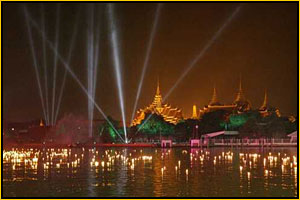

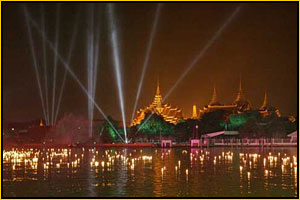
Loi Krathong or Yi Peng is a tradition that has been observed in Chiang Mai (and also in other cities) for almost 700 years now. Stories said that it was started by a royal princess who the first krathong shpated like a lotus as a present for the king during the ceremony of the festival. Since then the krathong became a recent addition and obviously so are firecrackers.

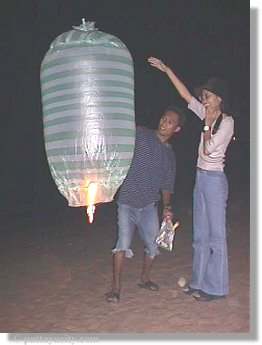
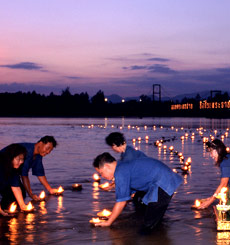
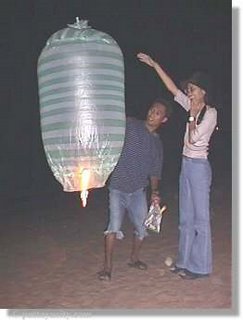
The festival is popularly known as Yi Peng from the word Yi (two) and Peng (full moon) festival (incidentally two full moon in a month is also called "Blue Moon" in other culture). People make krathongs from banana leaves where food, flowers, money, and other offerings are placed on together with lighted candles which they floated on the Ping River in the evening. They also release hot air balloons and lanterns made of saa paper or colored cellophance glued on a rectangular or cylindrical bamboo frame into air. The people believe that khratongs will drive away evil spirits and the prayers offered to the goddess of the river will give them abundant catch.
Yi Peng is celebrated also in the provinces. It is a well-awaited festival which draws not only the residents but also the visitors. The entire city, houses, shops, streets, canals, moats and the river is bedecked with lights and lanterns. The balloons that were released containing small-lighted candles gives a breath-taking scene as these float off into the dark sky. A spectacular sight nobody wanted to miss. Everybody seems to be on the street.

As Christians were taught not to participate in anything that is considered as pagan, we learned from the Old Testament people who always fall short of this law. We believe that "greater is He who is in us that the one who is the world" (1 John 4:4), and that no evil spirit can harm us, for "none can separate us from the love of God. The krathongs then can't do as it promised because of the truthfulness of the Word of God.
Meanwhile what we can do as Christians when it seems that the entire world around us is out there in the streets and celebrating? It was so ordered by our reverend king in the past. Do we want to be an outcast? Our people already branded us as people who embraced the religion of the western people who are actually subtly bringing in their culture, helping us to feel indifferent about our own culture, feeling it inferior against the other? A battle begins in our hearts then, because we believe that these traditions are part of our being, it's part of our culture that shaped our life, and to take these away is almost like renouncing our beginning. As Christians, we may ask then, how did Jesus react in the culture of his time? He surely has the same dilemma. Is He above the culture of His time, or He is beyond the culture?

I can't and I don't want to answer these questions. But let us heed instead on what was considered to be the first missionary has to say, "Therefore, my dear friends, as you have always obeyed--not only in my presence, but now much more in my absence continue to work out your salvation with fear and trembling, for it is God who works in you to will and to act according to his good purpose" (Phi. 2:12-13).

We all have traditions that we followed, some may look ridiculous but our ancestors surely did it with a purpose. Let us take a closer look of our culture and examine it. We may not necessarily have to reject them instead let us find some truths in it and in the light of the word of God, let us act accordingly. The Bible is the source of all truth, it will surely help us.

Friday, October 13, 2006

Theology in Culture

Missionary works have always been criticized of colonizing in the guise of bringing the gospel to a non-Christian country. This is rightly so because when one will study history, almost always the coming in of religion often results in radical changes in the culture. This is the reason why many Asian countries are so apprehensive of Christian missionaries especially those who come from the west for they know that almost always their culture will be dominated with Western ideas.

This is where Filipino and other Asian missionaries have advantage over western missionaries. Asian people don’t see us as a threat. However, it does not eliminate the idea that Christianity is a threat to nationalism. Usually, affiliation with the predominant religion is important part to national identity. A person who changed his religion is always seen as a traitor to his own country. Although nowadays, on the surface this seems acceptable, deep inside everybody knows that it is not so. This was true, in the Philippines a decade ago, when one become an evangelical Christian or protestant; the people close to you think that something very wrong had happened to you. To be a Filipino is to be a Catholic. However because of enormous growth and sophistication in evangelical Christianity today it is now largely accepted. This is not true in many South East Asian countries like Thailand, here being a Thai is being a Buddhist.

Filipino missionaries may not be guilty of ethnocentrism and may not be accused of cultural colonization, however, we sometimes are guilty of spiritual pride and religious superiority complex. I feel uncomfortable when fellow missionaries rebuke the spirits upon seeing a Buddhist temple and would condemn every act of worship in native religion as evil or demonic. When we as missionaries perceive that every religious and cultural practices are to be judged according to our presuppositions of what Christianity or spirituality should be then I could not imagine how could we effectively communicate to them the Christ of the gospel. We should learn to hold our judgment and take time to listen and learn.

The present challenge for missionaries is dialogue. It is the art of listening to what other religions are saying. It is to learn that other religions have something good to say and they have some kind of truth. They have something to contribute for the good of humanity. All religions have an equal right to be heard. Only through “dialogue” that we will understand their worldview and we can learn how to present the gospel that is acceptable to their culture. Only when we keep this in mind that we can teach the biblical truth that makes sense to them. Having an open mind and open heart is necessary for missionary work.

I may be biased here but theological knowledge plays a critical role in recognizing this interplay between theology and culture, between Christianity and other religions. It may take a lot of efforts and may receive unjustified criticisms of being “compromiser” from other more conservative Christian missionaries, but missionaries should be theologians in the sense that we need to find ways how to preach Christ that is not foreign to their culture perhaps to the extent that we need to use functional equivalents, parallels in culture, spiritual concepts, rituals, religious ideas and practices. Missionaries should consider these cultural elements as vehicle in expressing Christian beliefs and teachings.

Monday, October 09, 2006

C.S. Song's Third Eye Theology

I'm hoping to teach theology and culture here soon. Teaching younger Christian Pastors and leaders about theology here in the border of Thailand and Myanmar. Teaching in the mission field is not an easy task. I can hardly find the time to study and find the materials I needed to teach. I left my notes and books which are handful anyway because I could not really afford to buy imported books for they cost a fortune in Philippine peso. My theologian (younger) sister helped me out of this predicament by sending me the materials she used in teaching theology and culture class in the Philippines. I think it is a good idea to post some of the interesting ideas in here. This one is from Taiwanese theologian, a distinguished Professor of Theology and Asian Culture from Pacific School of Religon, Dr. Choan-Seng Song.

C.S. Song invites young theologians to do theology by using their third-eye, not the first nor second-eye-or a two-dimensional theology. Third-eye theology is derived from the Zen Buddhism in which there is an unheard-of region shut away from believers because of ignorance. Theology need not be seen only from the eye of the Germans as in what the Reformation represents. Theologians should not only see Jesus through the German eyes, nor American eyes but it should be seen also through the Japanese-eyes, African-eyes, Filipino-eyes, Latin American-eyes, Burmese-eyes and through multi-cultural eyes.

Song says that throughout the centuries, Jesus has been presented from the expression of the artist’s concept under the strong influence of their cultural and religious background. The face of Christ in art can be typological study of the cultural, national, and ethnic influences of the different artists: Donatelo’s Christ is marred with excruciating pain appealing to emotions—loneliness, abandonment, and the anguish of the voluntary sacrifice to atone the world from sins; Guido Reni’s face of Christ reflects physical suffering dominating all other pains, exaggerating the sentiments which is considered to be the evil-effects of Counter-Reformation; Giichro Hayakawa pictures the Christ with outstretched arms and nailed folded feet but in his face was no evidence of physical pain but deep contemplation on concentrating his all for the salvation of humankind.

Artists express their comprehension of Christ from their personal, historical, and cultural perspectives or context. This fact is not surprising because even the disciples viewed Jesus differently. Jesus Christ, for Christians, is the concrete expression of “who God is” and therefore, most Christians start doing the task of theology beginning with him. Who Jesus is and how he is relevant to the people of the culture is a good start.

I believe that this concept is true in proclamation of the gospel in a Buddhist country. With the shifting focus on the narrative aspect of theology, the telling and interpretation of the stories of Jesus is a good starting point in doing theology in Indochina where Christ is virtually unknown.