Showing posts with label Jesus. Show all posts

Friday, February 21, 2025

Jesus' Gift of Peace


Jesus said, “I leave you peace; my peace I give you. I do not give it to you as the world does. So don’t let your hearts be troubled or afraid.” -JOHN 14:27

In the Jewish culture, the Hebrew shalom is a customary greeting for both “hello” and “goodbye.” Shalom means “peace” and so much more. It implies a wish for health, prosperity, and wholeness. It also expresses a wish for an absence of both internal and external strife.

As Jesus prepared to say goodbye to his closest friends, it was the night of the Last Supper. He bid them shalom. Jesus’ words of farewell were far more than a traditional blessing. They were a gift only the Prince of Peace himself can offer. Jesus offered his followers peace of mind and heart. This peace was unlike the peace of the world they knew. It depended solely on his followers’ relationship with him.

These words of Jesus are like his Last Will and Testament. Just as a will records how to divide possessions among survivors, John 14:27 records our inheritance. Jesus bequeathed a priceless treasure to all those who follow him. In fact, his gift has set us up for life—both this one and the next. That’s because the wholeness found in Jesus’ gift of peace is at the heart of true happiness. As we pursue peace by pursuing Jesus, we’ll find we are holding the true key to living the good life.

Jesus’ gift of peace offers us an alternative to fear and worry, a foretaste of heaven available here and now. As with any inheritance, we have to accept it and use it to enjoy its true benefits.

Wednesday, September 19, 2018

Jesus: A Universal Icon


An idea is floating around that Islam is the fastest growing religion. Perhaps it's true. However, I still believe that the number of persons who know and believe in Jesus are getting bigger.  Below is an excerpt from the page of the book written by Richard Bauckham about the increased of number of persons who believe in Jesus.

Jesus of Nazareth, or Jesus Christ (as Christians call him), is undoubtedly the best known and most influential human person in the world history. Two billion people today identify themselves as Christians, with the implication that Jesus is the focus of their relationship to God and of their way of living in the world. Such followers of Jesus are now more numerous and make up a greater proportion of the world's population than ever before. It is estimated that they are increasing by some 70,000 persons every day.

This growth of Christianity is taking place despite its decline in the West, especially in Western Europe, and those who think the figure of Jesus Christ is of fading significance need to reckon with astonishingly rapid increase in numbers of Christian believers in other parts of the world, such as Africa and (who would have expected it?) China. Jesus is plainly no longer icon purely of the Western culture, but in fact he never was. He lived in the Middle East, and in the first few centuries of Christianity the faith spread in all directions--not only to Greece and Rome, France and Spain, but also to Egypt, North Africa, and Ethiophia, to Turkey and Armenia, to Iraq, Persia, and India. Christianity was a world religion long before it was a European one.

Richard Bauckham, Jesus: A Very Short Introduction. Oxford University Press, 2011.

Saturday, August 18, 2018

Book I Read: Jesus: A Very Short Introduction


Bauckham, Richard. Jesus: A Very Short Introduction. Oxford, 2011.

Two billion people today identify as Christians, with the implication that Jesus is the focus of their relationship with God, and their way of living in the world. Such followers of Jesus are now more numerous and make up a greater proportion of the world's population than ever before. Despite its decline in the West, Christianity is rapidly increasing in areas such as Africa and China. 

 Richard Bauckham explores the historical figure of Jesus, evaluating the sources and concluding that they provide us with good historical evidence for his life and teaching. In order to place Jesus in his proper historical context, as a Jew from Galilee in the early first century of our era, Bauckham looks at Jewish religion and society in the land of Israel under Roman rule. He explores Jesus' symbolic practices as well as his teachings, looks at his public career and emphasises how his actions, such as healing and his association with notorious sinners, were just as important as his words. 

 Bauckham shows that Jesus was devoted to the God of Israel, with a special focus on God's fatherly love and compassion, and like every Jewish teacher he expounded the Torah, but did so in his own distinctive way. With a discussion about the way Jesus understood himself and what finally led to his death as a criminal on a Roman cross, he concludes by considering the significance Jesus has come to have for Christian faith worldwide.

Wednesday, November 29, 2006

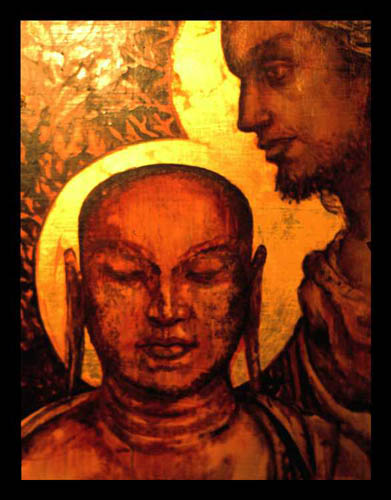
The Christ and the Buddha

Christians living in a predominant Buddhist country struggle on how they can speak about their faith that makes sense to their neighbors. On the surface, it seems that Buddhism and Christianity have very little in common. We have no choice but to begin on a common pointm, start from the subject you know they are famiilar with. Although sometimes, it will surprise you that they know little about the philosophy or theory of their religion. It is because their religion is not much of a matter of sophisticated theology that drives them to their religious practices. Even Buddhist thinkers would reject the rituals and some bizarre practices of a folk Buddhists but the folks do it anyway because they think that is what their religion demands from them and it makes them feel better.

My point here is it is good to teach them about their own belief and start a conversation. It is important to understand religious experiences express in the practices and learn as much as possible the theory behind the practice. This is the same with Christianity. There are underlying theories in our every religious experience and practice. It is sad enough that many Christians really do not understand the theory or the theology behind our practices such as worship, communion, baptism among others. Nonetheless, I appreciate evangelical Christianity emphasis on teaching and learning as part of being a church member. At least, through this we understand our doctrines that somehow explain some of our practice.

Dialogue between Christianity and Buddhist is possible only if at least one of the dialogue partners have knowledge of both faiths. And I believe the burden of learning other religion is on our shoulders to make our faith understandable. I admit, this is not easy but only through such interweaving of theory and practice, experience and reflection, will be able to put the dialogue between Buddhists and Christians about the message of the Buddha and the message of Christ. Hopefully, there are more similarities than differences.

Hans Kung names some of the similarities of the two religions. I have to depend on secondary sources by Hermann Haring on his book about Hans Kung because I don't have a copy of Kung's Christianity and the World Religions (I hope I can buy a copy in the future). Nevertheless, here Kung points out the similarity between the Christ and the Buddha. Both Christ and Buddha appear as teachers, proclaim good news, want to liberate human beings from their desires and their self-centeredness and point out a middle way, of selflessness, of concern for fellow men and women. That makes the difference all the more significant. Jesus was not solitary, but a master in an alternate community; no break can be established in hi life. The differences can be clarified most plainly by means of the distinction between a prophetic and mystical spirit.

The Buddha Gautama is a harmoniously self-contained peaceful, enlightened guide, inspired by the mystical spirit. Sent by no one, he demands renunciation of the will to life for the sake of redemption from suffering in nirvana. He calls for turning inwards, away from the world inward, for methodical meditation through the stage of absorption, and so finally to enlightenment. Thus he shows calm fellow feeling, with no personal involvement, for every sentient creature, man or animal; a universal sympathy and peaceful benevolence.

Jesus Christ, however, is a passionately involved emissary and guide, inspired by the prophetic spirit and, for many, even his own lifetime, the Anointed One (“Messiah”,”Christ”). He calls men and women to conversion for the sake of redemption from guilt and all evil in the kingdom of God. Instead of demanding a renunciation of the will, he appeals directly to the human will, which he bids orientate itself on God's will, itself aimed entirely at the comprehensive welfare, the salvation, of humankind. Thus he proclaims a personally concerned love, which includes all the suffering, the oppressed, the sick, the guilty and even opponents and enemies: a universal love and active charity.

These are some of the similarities. Other such commonalities and differences as well will be dealt with in the future posts.

About the image: The image is taken from MattStone Blog
created by Ruth Jones.