Showing posts with label sermon. Show all posts

Friday, January 06, 2023

Be Worthy of the Gospel of Christ

Today is the first day of the new year 2023. Many of us take this opportunity to change many things in our lives. We make resolutions but we do not keep them. In the start of the new year causes us to have to make real decisions.

Here are the top ten new year’s resolutions.

  • 10- Spend time with family
  • 9-Fall in love
  • 8-Help others
  • 7- Quit smoking
  • 6-Learn something new
  • 5-Staying fit and healthy
  • 4-Enjoy life to the fullest
  • 3-Spend less, save more
  • 2-Getting organized
  • 1-Lose weight

Today, we will think of one resolution that we should keep by. This one resolution is important because what we do with this resolution reflects our commitment tour Lord and Savior Jesus Christ.

In our passage today, we learn that the Apostle Paul is writing to the Church in Philippi about the importance of living for Jesus no matter what happens.

Whatever happens, conduct yourselves in a manner worthy of the gospel of Christ. Then, whether I see you or only hear about you in my absence, I will know that you stand firm in the one Spirit, striving together as one for the faith of the gospel… -Philippians 1:27

Let us all be worthy of the Gospel of Christ. How can we be worthy of the Gospel of Christ?

By our manner of life

Whatever happens, conduct yourselves in a manner worthy of the gospel of Christ. -Philippians 1:27

In the previous verses Paul speaks about the choices he wants with his life. His real desire is to be in heaven with Jesus. He wishes for that time, but he realizes that God has a plan and purpose for his life, so he needs to stay on the earth a little bit longer.

In verses 21-22, we can see how he thinks and feels.

21 For to me, to live is Christ and to die is gain. 22 If I am to go on living in the body, this will mean fruitful labor for me. Yet what shall I choose? I do not know!

Although Paul wants to be with the Lord, he needs to wait because God wants Paul to help others to grow in the grace and knowledge of Jesus.

In verse 27, he starts the verse by saying, “Whatever happens.” This means it is the most important thing in our life as a Christian. He is saying that no matter what happens we must follow this instruction.

So, what does the “manner of life” mean? This word usually means to refer to our life as citizens. As people, are we citizens of the country where we were born and live? Almost all of us are born in Thailand, then those are citizen of Thailand. Some of us are born in Myanmar. Then these people are citizen of Myanmar. Some of us were born in the Philippines.

What is so special about this word? The people of Philippi have a great pride of their Roman citizenship. They have the special privilege of living under a Roman colony. They know the honor and implications of their high status.

As a Roman colony, the city also has the highest privilege obtained from the Roman government. As citizens of Rome, they can buy and sell property. They are exempt from land tax and other taxes. They are also protected by Roman law.

We know that Paul is a Roman citizen. He used that citizenship so he can be released from prison. In using this word, the readers are encouraged to put the same pride and zeal into living as citizens of heaven.

Our citizenship has a higher standard than the great Roman empire. Our citizenship in heaven is more important than being a citizen of our great nation.

“But our citizenship is in heaven. And we eagerly await a Savior from there, the Lord Jesus Christ.” -Philippians 3:20

When we do not live up to being good citizens of our country, it reflects poorly on our country. When we do not strive to live a life worthy of the gospel, it will reflect poorly on God we serve and the heaven in which we are citizens.

What does it mean for us today? The challenge for us is we must let our manner of life be worthy of the gospel of Jesus. People will know how good God is if we are good. But people will not believe that God is good if our manner of life is not worthy of the gospel. Our life should reflect our heavenly citizenship.

By standing firm

Whatever happens, conduct yourselves in a manner worthy of the gospel of Christ. Then, whether I come and see you or only hear about you in my absence, I will know that you stand firm in the one Spirit, striving together as one for the faith of the gospel… Philippians 1:27

For Paul, standing firm is necessary to make our life worthy of the gospel. The Christians in Philippi should stand firm not for Paul. They must stand firm in Paul’s absence. Our motivation for standing firm is Jesus only. Not any other person.

The phrase translated “standing firm” is a military term used by a Roman soldier at his post. This is serious matter because if a Roman soldier fell asleep or failed to carry his duty he will be put to death.

This is what the word means used by Paul. This word is very meaningful to his readers. They know exactly what it means. For us today, we have different understandings of standing firm. We are to stand for Jesus as if our very lives depend on it.

We are called to stand firm in any and every circumstance. Too many times we let circumstances determine our decision and action. A Romans soldier could not say he fell asleep on duty because he was tired. He was to stand firm no matter what the situation.

Sometimes, when we face a difficult situation, when it involves some money, when it involves big effort, when it takes a lot of time, we failed to stand firm in the promises of God. I believe today many Christians have become situational Christians. Our faith depends on what situation we are in. Our God is bigger that our situation.

What does it mean for us? Just like Paul says, whatever happens, whatever the situation, no one will stop us doing ministries for our church. No one will stop us to worship God. Nothing will stop us from doing good in the name of Jesus.

By striving for unity

Whatever happens, conduct yourselves in a manner worthy of the gospel of Christ. Then, whether I come and see you or only hear about you in my absence, I will know that you stand firm in the one Spirit, striving together as one for the faith of the gospel

When we are united, we are strong. When we strive to be united in our vision, mission, and action we can accomplish great things for God. If we are not united, we cannot do so much. When we are standing firm together, our community will take notice.

Just recently Argentina became the champion in football. We all know that it is because of their teamwork. Because they are united. A team that is not united in purpose will not win even if it has the greatest player in the world. We all know that.

Even Messi will not win until he worked together and trusted his teammates. If a team is full of people who just care about their own accomplishments, the team will fail.

What does this mean for us? As Christians if our faith is only about ourselves, we will fail. If we think only about our own personal growth, we will not grow. We grow together as one. The only way we will grow in our spiritual life is if we will all grow together as one. God is calling us to strive for unity of spirit and mind.

The word of God is challenging us to be concern with the spiritual growth of our brothers and sisters in the church.

Conclusion

This new year we want to change. We may want to make resolutions. But God is challenging us to make and keep this one resolution for 2023.

Whatever happens, conduct yourselves in a manner worthy of the gospel of Christ.

  • By our manner of life
  • By standing firm
  • By striving for unity

Monday, May 03, 2021

Why Do We Worship Together?

Evangelical Christians came to Thailand almost five hundred years ago. Today only about 1.2% of people in Thailand are Christians. We are very few in a predominant Buddhist country. 

What makes it sad is that many people who claim to be followers of Jesus Christ do not attend worship services. More so, participate in church activities. Imagine if the 1.2% of Christian are faithful in attending worship service every Sunday. What do you think will happen?

Hebrews 10:22-25 says,

22 Let us draw near to God with a sincere heart and with the full assurance that faith brings, having our hearts sprinkled to cleanse us from a guilty conscience and having our bodies washed with pure water. 23 Let us hold unswervingly to the hope we profess, for he who promised is faithful. 24 And let us consider how we may spur one another on toward love and good deeds, 25 not giving up meeting together, as some are in the habit of doing, but encouraging one another—and all the more as you see the Day approaching.

Here in this passage, we will find three reasons why we worship together in church every Sunday.

We draw each other closer to Jesus (22)

Let us draw near to God with a sincere heart and with the full assurance that faith brings (22)

Why do we worship God in the church when we can worship Him everywhere? Anyway, God is everywhere, Jesus is everywhere. But the Bible says that worship is a special moment when Jesus is present. A presence that is different from his presence in the world. There is something special when we gather to worship him in this place. Verse 22 says it is because “draw near to God.”

Why do we come together here every Sunday? We come here to draw closer to our Lord Jesus Christ. We do not come to the church to hear a sermon, to listen to music, to fellowship with others or to give an offering. These are all good reasons, but the most important reason is we draw near to Jesus.

The book of Hebrew reminds us that in the Old Testament times, only the High Priest can go to the Holy of Holies to be in the presence of God. The ordinary people stay in the outer court and wait for the priest on what God will say to them. 

But today, when we worship together in this building, we all go directly to God. We don’t go in as individua, but we all go in together as a church, as a community. When we worship together we all go direct to God because of the blood of Jesus Christ. And because of that we are in the presence of Jesus whom we worship.

We declare our faith in Jesus (23)

Let us hold unswervingly to the hope we profess, for he who promised is faithful. 

Notice the word “unswervingly” this means “we do not change direction.” It seems that during the New Testament time there are many Christians who are “swerving.” They change direction. It means they stop coming to the gathering of believers to worship. In the New Testament time, when they stopped coming to meet with other believers. It meant they go back to their old ways of life.

In other words, in the New Testament time a person boldly declares his faith in Jesus if he regularly joined other Christians in worship. On the other hand, if he did not come to worship with others, he blatantly denied his faith in Jesus.

This is a challenge for us today, do you know that when we come to the church to worship, we declare our faith? It is like we are saying, “I still believe in Jesus Christ.

This is how important for Christians to be faithful in attending worship service. If a person is no longer coming to the church, then he cannot claim to be true follower of Jesus Christ. 

The church and Jesus Christ are not the same, but they are inseparable. If we are not faithful in attending our church worship service, then we are also not faithful to our Lord Jesus.

We have to make a firm decision to be faithful to the church of Jesus. Attending our church worship is not all our witness but it is a particularly important part of our witness. If we are faithful to our church, we are saying to the lost that we are faithful to Jesus.

I challenge everyone here right now, if we are all going to be faithful in attending our church worship.  I am sure, there will a significant increase of number of people who will come to the church and will believe in Jesus Christ. 

We encourage one another (24-25)

24 And let us consider how we may spur one another on toward love and good deeds, 25 not giving up meeting together, as some are in the habit of doing, but encouraging one another—and all the more as you see the Day approaching.

When we worship together, we also encourage one another. How do we encourage one another? 

First, we encourage others by our presence. When we come to the church, we are saying God is important.  Jesus is important and our brothers and sisters are important to us. When we are here you are saying I love Jesus and I also love my brothers and sisters in Christ. Isn’t that a big encouragement already?

Second, we can encourage our church family when we take part in worship. We don’t come here to watch but to worship; we do not merely come here to sing but to serve! We do not come just to listen but to do what we heard. When we worship with all our heart, we encourage others to worship with all their hearts. 

The truth is we need each other. It is our responsibility to encourage our brothers and sisters to love one another and to help them do good work. We should also inspire others to grow in their faith. 

We cannot grow in our relationship with God apart from other Christians. Our relationship with God grows deeper when our relationship with other Christians grows deeper too. 

How do we grow and encourage one another? When we worship God together our love for one another grows deeper and our faith in God grows stronger.

Conclusion

There was a church that was built in the 1550’s in (Doubes) France. In that church building they had no candelabra. They had no lights. The mayor of Doubes instructed everybody to bring his own lantern to the church. At the end of the pew there was a place where the people would hang their lanterns. 

As people would come one at a time, bringing their lantern to church, they would hang it at the end of the pew. And the more people came, the brighter the church building became. If no one came, the church building was in darkness. 

Every time we come to church to worship together; we are bringing the light of our Lord Jesus Christ. If we choose not to come, just imagine, we put out our light a little until the darkness overcomes us. If we come and worship together, our church light becomes brighter, and we defeat the darkness.

Why do we come and worship together? When we worship together, we draw closer to Jesus, we declare our faith in Jesus, and we encourage one another.

Thursday, April 09, 2020

Selah Amid COVID-19


The COVID-19 pandemic helps us realize that we are a community. We are not meant to live as an individual in our private world. Somehow, somewhere each one of us has a connection. Every action we do affects someone, in our country, in our town, in our community, our neighborhood, and our family.

The question we need to ask is after this pandemic is: “Will we ever be the same?” I hope our answer is: “No, we will never be the same. The worst that could happen is to go back to the way we were before. We must not stay the same. We must never be the same again.”

The sons of Korah wrote this song during a time of chaos, trouble, and uncertainty. This Psalm was written for the nation of Israel, but it applies to us today too. Reading this Psalm, we will notice the word “Selah” mentioned repeatedly in verses 3, 7, and 11.

The word “Selah” is a direct transliteration from the Hebrew. Psalms are songs meant to be sung. “Selah” refers to a musical rest. The singers stopped singing to take a breath. It also means a silent reflection.

Moreover, “Selah” can also be translated “to praise” and “to lift.” Perhaps the singers paused so they could think about what they had just sung in praise to God. It is something required for the singers to do. So “Selah” means that we should pause and praise God. Every time we see “Selah” while reading Psalm we pause, look up, and praise God.

1 God is our refuge and strength, an ever-present help in trouble. 2 Therefore we will not fear, though the earth give way and the mountains fall into the heart of the sea, 3 though its waters roar and foam and the mountains quake with their surging. (Selah) 4 There is a river whose streams make glad the city of God, the holy place where the Most High dwells. 5 God is within her, she will not fall; God will help her at break of day. 6 Nations are in uproar, kingdoms fall;he lifts his voice, the earth melts.7 The LORD Almighty is with us; the God of Jacob is our fortress.(Selah) 8 Come and see what the LORD has done, the desolations he has brought on the earth. 9 He makes wars cease to the ends of the earth. He breaks the bow and shatters the spear;he burns the shields with fire. 10 He says, “Be still, and know that I am God; I will be exalted among the nations, I will be exalted in the earth.” 11 The LORD Almighty is with us; the God of Jacob is our fortress. (Selah)

So while reading this Psalm, we can pause, look up, and praise God for:

His Promise: God Is For Us (1-3)

1 God is our refuge and strength, an ever-present help in trouble. 2 Therefore we will not fear, though the earth give way and the mountains fall into the heart of the sea, 3 though its waters roar and foam and the mountains quake with their surging. (Selah)

The word used here for God is “Elohim” which means that He is the Creator, King, Judge, and Savior. Regardless of what we are feeling in this troubled time. This is a reminder to us of God’s promises that He is our refuge, our strength, and our help. He is not asking us to go to a safe place. But He (himself) is our place of safety. The word “refuge” is a place of trust and literally, it means “to flee” running into an indestructible shelter.

God promised us that He will hide us in His shelter, and His strength will help us. He is a “very present help in trouble.” The word “very” means His help is great and abundant right now in our present situation. God’s help exceeds any kind of help that any humans can do. We should be glad that we are serving a God who is always ready to help when we are in trouble.

In verse 2, the writer imagines the worst calamity that may happen to us. Earthquakes, volcanic eruptions, and mountains slipping into the sea. It seems like the destruction of the planet earth. But even though the earth gives way” or the landscape suddenly changes, we don’t have to be afraid.

Verse 3 describes the roaring waters of the sea. This represents something so violent that we have no total control. Roaring means “to rage” or “to be at war.” COVID-19 is not as violent but it is a crisis that we don’t have total control. Every country is in a commotion on what to do next. Humanity’s sense of control has been replaced with fear and concern about the future. It’s fair to say that the entire world has been humbled by this pandemic.

This Psalm tells us that when our security is suddenly gone, we’re to seek refuge in God. Our sense of helplessness and fear should draw us nearer to God. We will echo the voices of many people of God that this tragedy should bring us to our knees and cause us to be a more humble world.

God says in 2 Chronicles 7:14. “If my people who are called by my name humble themselves, and pray and seek my face and turn from their wicked ways, then I will hear from heaven and will forgive their sin and heal their land.”

This pandemic is pointing us to the real problem—humanity’s pride, self-centeredness and spiritual brokenness.

His Presence: God Is With Us (4-7)

4 There is a river whose streams make glad the city of God, the holy place where the Most High dwells. 5 God is within her, she will not fall; God will help her at break of day.6 Nations are in uproar, kingdoms fall;he lifts his voice, the earth melts. 7 The LORD Almighty is with us;the God of Jacob is our fortress. (Selah)

God promises us shelter when we need it. We don’t have to look for Him because His presence is with us. In verse 4 the city of God refers to Jerusalem. It was a beautiful city but we all know that there is no river flowing through it like any other major cities during that time like Babylon has Euphrates, Egypt has Nile, Rome has Tiber. Jerusalem has not the physical river, but it had something even better—the presence of God.

The word “Most High” is Elyon, which refers to God as the highest of all. He is sovereign and supreme, and He is present with us. God’s grace flows like a river to bring gladness and joy to His people. While the ocean rages, God’s presence is depicted as a calm and gently flowing stream. This image in the Scripture is used to represent happiness, abundance, and peace, even when everything else is falling apart.

God’s presence with His people is one of the central truths of Scripture. Verse 5 says that “God is in the midst of her” and verse 7 declares that the “Lord of Hosts is with us.” This is from the root word “Immanuel,” which means “God with us” and was used in Matthew 1:23 to refer to Jesus. This means when we put our faith in Jesus, we have “God with us” at all times.

Notice the last part of verse 5: “God will help her at the break of day.” No matter how bad things get, God’s presence means He will help us. When we wake up to start a new day, we will experience what Jeremiah did in Lamentations 3:22-23: “Because of the Lord’s great love we are not consumed, for His compassions never fail. They are new every morning; great is your faithfulness.” God is faithful to us. He will never leave us or forsake us.

His Power: God Is Over Us (8-11)

8 Come and see what the LORD has done, the desolations he has brought on the earth. 9 He makes wars cease to the ends of the earth. He breaks the bow and shatters the spear; he burns the shields with fire. 10 He says, “Be still, and know that I am God; I will be exalted among the nations, I will be exalted in the earth.” 11 The LORD Almighty is with us;
the God of Jacob is our fortress. (Selah)

We can depend on God during times like this because of His promise, His presence, and finally, because of His power. Verse 8 says that God calls us to “come and see what the LORD has done.” The word “come” means “we are to run or pursue” in order “to see” or “to behold.”

It means “to perceive through sight, to gaze intently upon, to observe fully.” It expresses a strong feeling of hope, expectation, and certainty. “To behold” has the idea of vividness and emotional involvement. Here we are commanded, “to come and behold.”

There is a phrase that says, “We become what we behold.” A Pastor tells it like this: “Tell me what you are beholding, and I’ll tell you what you are becoming.”  When we behold the Lord and His works, we become like Him and do His works. I believe in this COVID-19 pandemic many people are seeking the Lord right now.

Verse 9 shows us that in His position as the Almighty God, He makes “wars cease to the ends of the earth; He breaks the bow and shatters the spear, He burns the chariots with fire.” We believe that the LORD has the power to stop the war.

Sometimes we feel like that there is nothing we can do to stop COVID-19. We may even feel helpless and even hopeless. This pandemic helps us realize that we don’t have control over the details of our lives. But God is in total control.

In verse 10, we are called to “be still and know that I am God.” To “be still” means to “cast down or let fall” and was used to the idea of dropping weapons. We have to stop fighting a battle we can’t win.  We are not to just have a “moment of silence” or even to just be quiet. We are to cease, surrender to God, and let go.

The purpose of being still is so that we can know God. To “know” means “to acknowledge and comprehend, to discover intimately.” It is not just enough just to know about Him; we must have a deep personal relationship with Him. To do that, we need to be still before Him, pray and listen to His words.

The last part of verse 10 says that “I will be exalted among the nations, I will be exalted in the earth!” Ultimately, all nations will exalt God. Jesus will come again and all the nations will surrender before Him. No matter what happens, in this pandemic: God will be exalted among the nations and He will be exalted in the earth. He is working out all things for His glory and our ultimate good.

Verse 11 is a great summary statement of this entire psalm as it repeats verse 7. Because “the Lord of hosts is with us, and the God of Jacob is our fortress,” we can trust Him.

Conclusion

Jesus Christ is God and Lord of history. Nothing has happened outside of His plan. Through worst disaster, though the mountains fall into the sea, if we believe in Jesus we have nothing to fear.  Whether COVID-19 pandemic leads to more catastrophe and confusion, or the nations rage against one another, God is our refuge.

No matter what happens, we can pause, look up and praise Him for His promise, His presence, and His power.

Let’s pause here at the final “Selah” and praise God for His power. It’s time to be still and surrender before Him because we know that He is the most powerful God.

Photo is from South China Morning Post
Adopted from Pastor Brian Bill’s Sermon

Wednesday, March 25, 2020

If the Lord's will


James 4:13-17


We are now living amid COVID-19 crisis. Our President declared a nationwide lockdown to stop the rapid spread of the coronavirus. It is important to follow the government during this troubled time. I understand that we should be together for prayer and worship. But wisdom declares that we should stay at home and not to gather. We want to stop the virus from moving around. If people keep moving around, we are making a way the virus spread rapidly more than our healthcare professionals and front-liners can handle.

It is in time like this that we also the best and worst among us. I believe that people are good, God created us in His own image anyway. Sin may have marred God's image in us but it still there. However, in a situation like this, sin also exposed the worst among us. Our self-centeredness.
We are going to see from our text that self-centeredness sickness infected even Christians. We can read it in James 4:13-17. We will learn that the cure for self-centered sickness is following the will of God.
“Come now, you who say, ‘Today or tomorrow we will go into such and such a town and spend a year there and trade and make a profit’— yet you do not know what tomorrow will bring. What is your life? For you are a mist that appears for a little time and then vanishes. Instead, you ought to say, ‘If the Lord wills, we will live and do this or that.’ As it is, you boast in your arrogance. All such boasting is evil. So, whoever knows the right thing to do and fails to do it, for him it is sin.”
Verse 13 gives us the symptoms of our disease: “Come now, you who say, ‘Today or tomorrow we will go into such and such a town and spend a year there and trade and make a profit.’” People, even Christians make plans without any regard for God’s will.

The statement “come now,” is found only in this verse. It is a forceful warning to businesspeople. In James’ day, sellers would buy goods from one city and travel to a distant city and remain there until they sold those goods at a profit. Then with the profit, they will buy goods from that city and move to another city to sell the goods.

These business people had a good business plan. They had everything figured out or so they thought. They answered all the questions:
  • When? “Today or tomorrow”
  • Where? “such and such a town”
  • How long? “spend a year”
  • What? “trade”
  • Why? “make a profit”
It was a good plan, but they forget the most important question—who? God was not included in the plan. Having a plan is good but planning without acknowledging God is.

Making plans is a good thing but planning without acknowledging God is selfishness and arrogance. Acknowledging God’s will over our lives is a cure for our self-centeredness sickness.

Admit we do not know the future (14)

Listen to the first part of verse 14: “Yet you do not know what tomorrow will bring.” We don’t know what will happen tonight, much less next week or next year. Proverbs 27:1: “Do not boast about tomorrow, for you do not know what a day may bring”. The COVID-19 pandemic proves this point. The only time we know for sure is this time, right now.

Yesterday is called “the past” because it has already passed. Tomorrow is yet to come. To be honest, we will not know what will happen tomorrow. That is why, a quotation says: Yesterday is history, tomorrow is a mystery, and today is a gift—that is why it is called the present”.

The rich fool made plans he thought would give him security for the rest of his life. He planned for what he knew would happen, but according to Luke 12:20, he was caught unprepared, “God said to him, ‘Fool!’ This night your soul is required of you, and the things you have prepared, whose will they be?’”

We don’t know our future; our future is in God’s hands alone. Unless we commit ourselves and our plans to God, our future is meaningless.

Acknowledge the brevity of life (14)

Life is not only uncertain; it’s also short. We see this in verse 14: “What is your life? For you are a mist that appears for a little time and then vanishes.” J. B. Philips version says it this way: “You are like a puff of smoke visible for a little while and dissolving into thin air.”

The Greek for “mist” is atmos, from which we get the word “atmosphere.” James is thinking of the morning mist which appears for a “little time” and goes away when the sun comes up. The word “vanishes” has the idea of utterly disappearing.

Have you ever thought of yourself as fragile as the mist? You’re here one moment and then gone the next. Even if you live to be 100, time goes by quickly and like vanishing steam from a hot cup of coffee, you will eventually evaporate from the earth.

Brothers and sisters, life is too uncertain and too short to live it without God at the center. We count our lives in years, but God tells us in Psalm 90:12 to number our days. Everyone in this room is just one heartbeat away from eternity.

Because life is short, live as if this is the last day of your life. Have you admitted ignorance about the future? Have you acknowledged the brevity of life?

Align with God’s will (15)

The third directive is found in verse 15: “Instead you ought to say, ‘If the Lord wills, we will live and do this or that.’” We’re called to move from arrogant independence to dependence upon God. God is actively and personally involved with His people. Because He has plans and purposes for us, we must seek Him and His will. The little word “if” makes all the difference. “If” the Lord wills, we will live and do this or that.

No amount of money, influence, power, or planning can guarantee tomorrow. Only God can grant us another sunrise or another breath. Let’s declare with David in Psalm 31:15: “My times are in your hand.”  It would be helpful for us to say, “Lord willing” whenever we make plans. The key is not to make this phrase a trite formula but to really mean, “If the Lord wills.”

One commentator offers this helpful insight:
  • We should refer to God’s will.
  • We should defer to God’s will.
  • We should prefer God’s will.
It’s not wrong to make plans, but we must make sure they align with God’s purposes. Proverbs 19:21: “Many are the plans in the mind of a man, but it is the purpose of the Lord that will stand.”

Avoid arrogance (16)

According to verse 16, God does what He chooses in my life. Therefore, I must accept what He chooses to do: “As it is, you boast in your arrogance. All such boasting is evil.” The word “boast” means to exult oneself higher than God.

If we plan without aligning ourselves with God’s purposes, we become arrogant. 1 Corinthians 5:6: “Your boasting is not good…” We might call ourselves Christ-followers but by leaving God out of our lives, we are acting like atheists. Boasting is evil because we are defying the true state of our lives and living like we don’t need God for anything.
I appreciate Charles Spurgeon’s advice for conquering pride:
  • Embrace your Nothingness – “Be not proud of race, face, place, or grace.”
  • Embrace Christ – “Pride cannot live beneath the cross.”
  • Embrace Suffering – “The benefit of the furnace; it melts, tries, and purifies.”

Act in obedience (17)

We’ve been challenged by the Book of James to live out what we’re learning. The final directive is found in verse 17: “So whoever knows the right thing to do and fails to do it, for him it is sin.” This literally reads, “sin it is to him.” This attitude says something like this, “God, I know what you want me to do, but I’m not going to do it. I know better than you do.”

Some of us think we haven’t done anything bad, so we’re good to go. Perhaps we even point out others who’ve done awful things. But the truth is we can sin by doing nothing. It was Edmund Burke who said, “All that is necessary for evil to triumph is for good men to do nothing”.

James is addressing the sins of omission, which result from failing to do something God’s Word commands us to do. A sin of commission is a sin we actively commit.

The best way to deal with the future is to be faithful today. Now is always the right time to act because it is the only time you can be sure of it. The only moment you can guarantee is this moment. When you procrastinate doing the right thing, you end up doing the wrong thing.

We could say it like this: Delayed obedience is disobedience. Do you have any delayed obedience in your life? Do you know what God wants you to do or to stop doing, but you’ve been delaying?

Conclusion

We are living in uncertain and dangerous times. Nobody knows what will happen in the future. There is a quote that says: “We do not know what the future holds but we know who holds the future”. The safest place in the world is if we are in the will of God. We do it by admitting that we don’t know what will happen in the future, acknowledge that life is short, align our will with God’s will and we should act in obedience.

Friday, February 14, 2020

Valentine’s Day Thoughts


28 One of the teachers of the law came and heard them debating. Noticing that Jesus had given them a good answer, he asked him, “Of all the commandments, which is the most important?”29 “The most important one,” answered Jesus, “is this: ‘Hear, O Israel: The Lord our God, the Lord is one. 30 Love the Lord your God with all your heart and with all your soul and with all your mind and with all your strength.’ 31 The second is this: ‘Love your neighbor as yourself.’ There is no commandment greater than these.” 
Mark 12:28-31

There is a story you all probably know already about a teacher who wants to teach about time management to his class. He walked into the room and put a glass jar on the table. Then he took out about a dozen rocks and put them into the jar one at a time. When the jar was full to the top and no more rocks would fit inside, he asked, “Is this jar full?”

Everyone in the class said, “Yes.”

“Really?” he said. Then he reached under the table and pulled out a bucket of gravel. He dumped some gravel into the jar and shook it, causing pieces of gravel to work themselves down into the spaces between the big rocks. Then he smiled and asked the group once more, “Is the jar full?”

By this time the class was starting to catch on. “Probably not,” one of them said.

“Good!” he replied. Then he reached under the table and brought out a bucket of sand. He started dumping the sand in and it filled all the spaces between the rocks and the gravel. Once more he asked, “Is this jar full?”

“No!” the class shouted.

Again, he said, “Good!” Then he grabbed a pitcher of water and began to pour in the water until the jar was full to the brim. Then he looked back at the class and asked, “What is the point of this illustration?”

One eager student raised his hand and said, “The point is, no matter how full your schedule is, if you try really hard, you can always fit something more into it!”

“No,” the teacher shouted, “that’s not the point. The truth this illustration teaches us is this: if you don’t put the big rocks in first, you’ll never get them in at all.”

He made his point. The problem is—sometimes it is hard to know what the big rocks are supposed to be in our life. We need to know what the most important thing and we need to give them priority in our life.

What about Jesus? Have we ever wondered what is important to Jesus? Many of the teachers of the law were debating what was the most important law for Jesus. It is unbelievable that they identified 613 specific commandments in the Old Testament. We can narrow it down to the 10 Commandments. Which one is the most important? Which one took top priority? They would debate endlessly.

They wanted Jesus to be involved in the debate, so they asked Him. Jesus’ answer to this question would show a great deal about his own heart and the heart of God, the Father. Jesus set down where to start, what matters most to God, what big rocks should be.

When they asked Jesus, “Which of the commands is most important?” He answered that the most important commandment is the command to love.

Love the Lord your God (29)

29 “The most important one,” answered Jesus, “is this: ‘Hear, O Israel: The Lord our God, the Lord is one. 30 Love the Lord your God with all your heart and with all your soul and with all your mind and with all your strength.’

Jesus’ answer is a quote from the Old Testament. This is the Shema from Deuteronomy 6: 4-9:

4 Hear, O Israel: The Lord our God, the Lord is one. 5 Love the Lord your God with all your heart and with all your soul and with all your strength. 6 These commandments that I give you today are to be on your hearts. 7 Impress them on your children. Talk about them when you sit at home and when you walk along the road, when you lie down and when you get up. 8 Tie them as symbols on your hands and bind them on your foreheads. 9 Write them on the doorframes of your houses and on your gates.

Each word from this sentence is significant. Throughout the Bible, the word for heart (kardia) includes the physical, emotional, and spiritual life of a person. The heart is the source of our feelings and emotions. Feelings like joy, sorrow, depression, happiness all come from the heart. To love God with all your heart means to love God deeply and personally—like the love between husband and wife and parents to their children.

Love the Lord your God with all your soul. The word soul (nephesh) refers to the entire life of a person—sleeping, eating, working, and walking. Everything about us. Our soul is both who we are and what we are. If someone will ask you who you are, you might tell him your name. But your name does not describe who you are. If you want to be more specific you might say what is your work, where do you live, you are married, and you have a family with three children. Most importantly, you will say that you are a follower of Jesus. Loving God with all your soul means that God defines who you are and what you are.

Jesus then adds the word that is not originally in the Old Testament. He says to love God with “all your mind.” This is all about our thinking and learning. Loving God with all your mind implies centering our education on him—learning and growing in our ability to know Jesus deeper. We need to study about God, we need to learn more about Jesus until his love, power, and grace overcome us.

And then Jesus says to love God with “all your strength.” The strength here has nothing to do with the amount of weight we can lift. This is about how and where we put our energy—our work, our jobs, and our daily activities. Paul explains what it means to love God with all your strength when he says, “In all the work you are doing, work the best you can. Work as if you were doing it for the Lord, not for people (Col. 3:23).

When we put all these truths altogether, this passage has a big impact in our lives. Jesus is telling us to love God with our whole self—every cell, every fiber of our being. It is a hard command. It’s hard enough to love a spouse or children who we can see and touch. How are we supposed to love God with all our heart, soul, mind, and strength? We can do this through the help of the Holy Spirit.

How can we love someone who we do not know personally? We can love God with all our whole being we know Him very well. As we know Jesus more and more, we learn to love him more, and He opens our hearts to greater love. God wants us to know him, not to know doctrine or religion or system or creeds.

This is a challenge for us. Where does our knowledge of God come from? From his Word and from His people God uses to teach us about God and about Jesus. We need to study God’s word deeply and listen to the good teachers of the Word of God. Furthermore, we need to apply everything we learn about Jesus in our lives.

Hopefully, it’s becoming obvious why Jesus said that this is the greatest command. But Jesus not only gave the greatest command, but he also gave the second greatest as well.

Love Your Neighbor (31)

31 The second is this: ‘Love your neighbor as yourself.’ There is no commandment greater than these.”

When Jesus said, “The second command is this: ‘Love your neighbor as you love yourself,’” he was still quoting from the Torah—Leviticus 19:18 to be specific. And this was also an often-misunderstood passage.

Do not seek revenge or bear a grudge against anyone among your people but love your neighbor as yourself. I am the Lord.

During Jesus’ lifetime, the teachers of the Law were busy arguing what is the meaning of the word neighbor. For most of them, a neighbor was a Jew who faithfully followed the Law. People who were not Jews were considered enemies.

Jesus wanted to broaden their definition of neighbor, so he told them the story of “The Good Samaritan” to teach them that a neighbor is a person we meet who needs help. The question is not “Who is my neighbor?” but “Am I a good neighbor?” Loving our neighbor means loving and helping the people around us.

Loving our neighbor is the second greatest commandment, second only to loving God because loving people is just an extension of loving God. Jesus couldn’t have given us the greatest command without giving us the greatest command, because the two are always together. Loving people is evidence that we love God.

How do we show our love to God? We can use our words to express our love to God through our worship, prayer, or singing. We can even spend quality time with God through devotionals or Bible reading. We can show love to God by loving the body of Christ—the church. Furthermore, we can show love to God by serving the church and serving the people.

How do we give gift to God? We give gifts to God by giving to the church and by giving to other people. When we serve, touch, and give gifts to other people, we are doing it for God. Jesus says, “I tell you the truth, anything you did for even the least of my people here, you also did for me (Matt. 25:40).

Loving God means loving people. It means going out of our way, giving our time and using our resources to help the people in need around us. When we do this, we are fulfilling the greatest commandment. Ultimately, we fulfill it when we share with them the love of God. When we share our loving relationship with God to our neighbors, we obey the greatest commandment.

How do people around us know that we are Christian? We may answer that people know because we go to church. Or because we believe in Jesus, that he died for our sins and that we have eternal life. We can answer because we read and believe the Bible. We may answer because Jesus change my life and I’m now a new creation. These are all correct answers, this is so true. But Jesus says that “all people will know that you are my followers if you love one another” (John 13:35).

Our greatest testimony as Christians is our obedience to the greatest commandment: To love God with all our heart with all our soul with all our mind with all our strength and to love our neighbor as ourselves.

Conclusion

Perhaps the question is we need to ask is how we love. The Bible is very clear about this in 1 Corinthians 13:4-8:

4 Love is patient, love is kind. It does not envy, it does not boast, it is not proud. 5 It does not dishonor others, it is not self-seeking, it is not easily angered, it keeps no record of wrongs. 6 Love does not delight in evil but rejoices with the truth. 7 It always protects, always trusts, always hopes, always perseveres. 8 Love never fails. --1 Corinthians 13:4-8

While reading this, we realized that no one among us here can do this. When it comes down to the most important commands God has given, not one person has ever kept them fully in all of history. No one except Jesus. He is the only one of us who ever lived the commands to love God and love people. We can only love like Jesus if He is the King and Lord of our life.

In fact, it sounds so true when we replaced this passage with the name of Jesus. Jesus is patient and kind. Jesus is never envy, not proud. He never dishonors others, not self-seeking, not easily angered. He keeps no record of wrongs. He does not delight in evil but rejoices with the truth. He always protects, always trusts, always hopes, always perseveres. Jesus never fails.

Adopted from Pastor Scot Bayles’ message.

Thursday, October 13, 2016

Sigh... Been Neglecting This Blog

I have been neglecting this blog and I feel bad. I am doing a lot of blogging about our ministry projects and I thought to myself, why should not have my own blog. Then I remember I have one which I have been neglecting. I hope to revive this and write about my theological thinking which I have not been really doing lately except for sermons that I write when I do my regular preaching.

Saturday, March 14, 2015

Love Within the Body of Christ

Romans 12:9-10 Untitled
9 Love must be sincere. Hate what is evil; cling to what is good. 10 Be devoted to one another in love. Honor one another above yourselves.
I remember in our church every time we had finished taken the the Lord Supper, we would read the Church Covenant and there is a part there that says:
“We moreover engage that when we remove from this place, we will as soon as possible unite with some other church, where we can carry out the spirit of this covenant and the principles of God’s Word.”
These words remind me that wherever we go as family, the first priority for us to look for a local church where we can serve God. So it makes me sad that many people claims to be Christian but do not want to be part of a local church. It just doesn’t make sense. In order for us to have a clear understanding of or passage, we have to read it in its context. In verses 1 and 2, Paul talks about spiritual worship and in verse 3 to eight, he talks about our humble service to the body of Christ by using our spiritual gifts. We need to understand that Paul refers specifically to the local church because every believer should commit to serve God through a local church.

Some believers would make excuse that it is not necessary because they are part of the universal invisible church. Warren Weirsbe tells a story of a free-lance missionary that visited a pastor friend asking for financial support. "What group are you associated with?" his friend asked. The man replied, "I belong to the invisible church." His friend then asked, "Well, what church are you a member of?" Again he got the answer, "I belong to the invisible church!" Getting a bit suspicious, his friend asked, "When does this invisible church meet? Who pastors it?" The missionary then became incensed and said, "Well, your church here isn't the true church. I belong to the invisible church!" His friend replied, "Well, here's some invisible money to help you in your invisible church!" God called us to serve Him in a local church through our worship (12:1-2), our service by using our spiritual gifts and then by loving our brothers and sisters in Christ.

 This morning the word of God challenges us to follow Jesus command to love one another. We follow Jesus example when he demonstrates his love when he died on the cross to suffer in our behalf. He did not do that because he wants to do something nice for us but because of his obedience to the Father. By following Christ’s example, we are commanded by the Father to love every person in the body of Christ.

Love in the body of Christ must be sincere (12:9a)

The English word “sincere” comes from two Latin words meaning “without wax.” In Paul’s time, potters would sometimes take wax and fill in the gaps in broken or cracked pottery. Then they would paint over the wax and sell it. The only problem was that when someone bought this pottery and put something hot in it the wax would melt and it would leak. Good potters distanced themselves from this practice by saying that their pottery was “sine-cere,” meaning it was pure with no wax. Likewise, our love must not have cracks in it, or wax that is simply a cover-up. The Greek word that Paul uses means “without hypocrisy.” The word was used of the masks used by actors on the stage.

 During Paul’s time, the actors used the mask to show the role that he was playing not his true character. Paul says that our love for one another should be without mask, but rather should be real. We should truly desire God’s best for others. Now, I think the question is how we can love our brothers and sisters in Christ in the church, John puts it very clearly in 1 John 3:16-18, “We know love by this, that He laid down His life for us; and we ought to lay down our lives for the brethren. But whoever has the world’s goods, and sees his brother in need and closes his heart against him, how does the love of God abide in him? Little children, let us not love with word or with tongue, but in deed and truth.”


Love in the body of Christ must be holy (12:9b)

Hate what is evil; cling to what is good. In order for love to be sincere, it must also be discerning. Love should know what is good and what is evil. It never endorses or encourages in others attitudes or behaviour that is evil. Rather it embraces what is good in God’s sight. God’s standard of what is evil and what is good does not change with the times or with different cultures. God reveals his holy standards of right and wrong in His Word. For example, when the Bible say that homosexual behaviour is sinful, then it does not changes even if public opinion polls or scientists say it is acceptable. If it is sin in God’s sight, then it is not loving to treat such behaviour as morally acceptable, because sin hurts people. Instead, the loving thing to do is to gently and with compassion, tell that person about his sin and point him to Christ so that he can be saved before his sin destroys him.

 Also Paul does not just say to avoid evil, we are to hate it. It is an strong emotional reaction against all that do not please God. Since God hates sin, we should also hate sin. We should not laugh at evil or be entertained by evil. The opposite of hating evil is to cling to what is good. The word “cling” is quite descriptive. It means to stick to something like glue; to hold fast, to join or keep company. It has the idea of tying ourselves to what is good. We must focus our minds on what is good and make sure that we keep company with people who will build us up, make sure we’re connected to church, and that we’re equipped to serve. We can flip it because they are really two sides to the same coin. The more you cling constantly to what is good, the easier it will be to hate what is evil. The word “good” was used of things that were morally good and beneficial or useful for a productive Christian life.
7 For God did not call us to be impure, but to live a holy life. 8 Therefore, anyone who rejects this instruction does not reject a human being but God, the very God who gives you his Holy Spirit. -1 Thessalonians 4:7-8


Love in the body of Christ must be brotherly (12:10a)

Be devoted to one another in brotherly love. Here Paul is challenging us to love as family members love. Here’s the deal. When we come a Christian we only get a birthday present called spiritual gift, we also become part of a new family. Each one of us is a child of God so we are a brothers and sisters to each other. The Christian community is composed of people from very different cultures. In the New Testament the church is composed of Greeks, Jews, Barbarians, Slaves, and free men and women but because of their faith they become one family in God.

 I believe it is not different from our present situation, we are all very different people but because of our faith in Christ, we become one family. Everyone of us has a family. There are times when we are not in talking terms with a member of our family. We fight, we argue and don’t talk with each other for a long time but we still love each other. The kind of love we should express within our families, is to be the kind of love God expects for us to express within the local Church: The church, is first and foremost the family of God, and each member of that family is important, with no distinctions, no discriminations.

Love in the body of Christ must be humble (12:10b)

Honour one another above yourselves.
The word “honour” literally means to put a “heavy weight.” It implies that we assign the greatest possible weight to a person in terms of respect by holding them in “high regard.” To honour someone is to measure his or her value on a scale and conclude that it is “heavy.” On the other hand, to “dishonour” means to treat someone as if they were “light or insignificant.” It would be used to describe a child that treats his parents lightly because he or she does not value them. We’re called to prefer others above ourselves. The idea is that we will take the lead in showing the honour that is due to each other in the family of God.

 This passage means that we do not wait around for people to recognise what we are doing good and praise us. Instead, we should be alter to what others are doing good and honour them. We are not to seek honour for ourselves, but rather we truly rejoice when others receive honour and we don not. It is easily said but it is hard to practice. If we will keep this principle in our hearts we will never look down upon other people especially our brothers and sisters in the church because at the very moment we look down on them, we actually are putting ourselves lower than them.

 Let us think of this truth always if you heard someone who are putting down a brother or a sister in Christ consider other Christians as second class citizen, according to God’s Word he or she is actually lower than the person he is putting down. So when Paul says, “honour one another above yourselves,” he doesn’t mean that we should deny our gifts or knowledge. Rather, he means that we should have a true estimate of ourselves. We should not over-estimate ourselves and under-estimate others. As Paul says in 1 Cortinthians 15:10, “But by the grace of God I am what I am, and his grace to me was not without effect. No, I worked harder than all of them—yet not I, but the grace of God that was with me.”

Conclusion

It would not take you too long to live in Mae Sai to realise that some Christians lack commitment to a particular local church. And I cannot blame them, there are just too many local churches here. They have a lot of options. I know a village that have five small churches and two Bible schools. I wonder how much influence they have in the community. In fact, I know a Christian leader who moved here last year and in just a few months was able to start a new local church disregarding local churches that are already existing. I am not saying that it is bad, I even think it is good. But I believe if we Christians want to have a weight in this predominantly Buddhist nation, we should better get our acts together.

And we can start by committing ourselves to a local church: commit ourselves to Jesus Christ who is the head of the church and commit ourselves to the members of the local church we are a part. How can we do that? By keeping this verse always in our hearts: Love one another sincerely, hate evil and cling to what is good, be devoted in loving one another like a family and honour one another above yourselves.

 Before I close I want to read part of the church covenant: We engage by the aid of the Holy Spirit, to walk together in Christian love; to strive for the advancement of this church, in knowledge, holiness and comfort; to promote its prosperity and spirituality; to sustain its worship, ordinances, discipline, and doctrines; to contribute cheerfully and regularly to the support of the ministry, the expenses of the church, the relief of the poor, and the spread of the gospel through all nations.

 We further engage to watch over one another in brotherly love; to remember each other in prayer, to help each other in sickness; to be slow to take offense, but always ready for reconciliation.

Monday, December 01, 2014

Thanksgiving Message

Philippians 4:4-7


We non-Americans will never fully understand why the Americans celebrate thanksgiving. Sure we can know its history and how it is being celebrated, but for us it is totally an American holiday just like Loi Khratong is a Thai festival. We may know about it and participate in it but we it would not be meaningful if we are not a Thai.

Charles Dickens once said that they are somewhat mixed up in America. He told an audience that “instead of having one Thanksgiving Day each year we should have 364 “days of thanksgiving.” Use that one day just for complaining and griping,” he said. “Use the other 364 days to thank God for the many blessings He has showered upon you.”

As Dickens suggested, we should not wait for a special holiday to express our gratitude to God. Instead, thanksgiving should be a part of our daily lives. In fact the bible is very clear that thanksgiving is perhaps one of the most vital characteristics of any child of God. And there’s good reason for that.

As a Christian, God expects us to have a thankful spirit. We should be the example of what it means to be a thankful person.

Let us look at Philippians 4:4-7 to know how we show to people that we have a thankful spirit.

A thankful spirit is a joyful spirit (v. 4)

Rejoice in the Lord always. I will say it again, rejoice.

A thankful person is always rejoicing in the Lord. As you may already know, when Paul was writing this letter he was not in a comfortable position. He was actually in prison. The reason we have a joyful spirit is because we know God through our personal relationship with Jesus.

The joy we have inside our hearts should not be affected by the bad circumstances that are happening around us. Paul shows this truth to us. He is full of joy because he knows that no matter what happened to him, he has Jesus Christ in his life. We can be joyful because we know for sure that God will provide for us and takes care of us.

And God will supply all your needs according to His riches in glory in Christ Jesus (Philippians 4:19)
Paul tells us to rejoice in the Lord always. Whether we like it or not, we are commanded to  do so not because we could not do it but because it is something that a true Christian should be doing. It is our testimony of how faithful God is to us.

We rejoice because he makes us happy. We rejoice because he gives us exceeding joy. In this passage Paul are trying to resolve some problems in the church, but in spite of that Paul tells us to rejoice in the Lord always!

To rejoice means to be exceedingly glad The ability to rejoice or to have a joyful spirit is built on our relationship with God, not with what is happening around us.

A thankful spirit is a gentle spirit (v. 5)

Let your gentleness be evident to all. The Lord is near.

Joy is not always evident but the way we relate to other people is. A thankful person will treat people as Jesus would treat them.

The word “gentle” is very difficult word to translate in English. One word is not sufficient to get the full meaning of it. Different translations translate it as gentle, moderate, kind, reasonable, considerate.
The word refers to a spirit that is reasonable, fair-minded, and charitable. It describes someone willing to yield his or her own right to show consideration and gentleness to others. We may find it easy to be gentle with some people but it is hard to be gentle to the people who makes our life difficult.

Paul is saying that “gentleness”  towards all people should characterise the people of God. He is calling the Christians in Philippi and us for that matter to have the gentle forbearance and meekness of Jesus. It should be one of the most prominent attitude that Christians should show to all people.

The sudden inclusion of the sentence, “the Lord is near” is ambiguous. Paul could have intended it to be like that. First, it may mean that Paul is saying “Rejoice in the Lord always,  and let your gentleness be evident to all for the coming of the Lord is near. On the other he may mean to say that the Lord is always near. Or he says it to mean both.

In the light of the persecution the Christians are experiencing in the hands of those who proclaim that the emperor is Lord and God. These words, I believe, serve as encouragement and affirmation.  That they can do all these commands because the Lord’s second coming is very near and while he is not yet coming…the Lord is near in a very real way to those who are praying to him.

And because of these truths, we are motivated to be gentle to the people who live around us. First, to our brothers and sisters in Christ and second to those who are lost.  A thankful person will treat other with love and respect.

A thankful spirit is a trusting spirit (6)

Do not be anxious about anything, but in every situation, by prayer and petition, with thanksgiving, present your requests to God.
Circumstances will not shake us. A thankful person  will have full trust in God. This verse literally is saying to us that we should stop being anxious! We should stop worrying. This is the scope of our trust. We are to trust God in every situation.

Three words are use for prayer here: prayer, petition and requests. I looked at the definition of these words. Petition is a formal written request, typically one signed by many people, appealing to authority with respect to a particular cause. A request is an act of asking politely or formally for something.

So this verse clearly tells us that if something is making us anxious we have to pray to God and we have to pray together to God and trust him that he will take care of it.

We cannot let circumstances shake our faith. Anxiety can cause to be irritable and defensive. It is like a fertiliser that make little problems grow bigger. The church at Philippi are having internal problems and it is causing disagreement among the Christians there. It might have been easy for the church to just stop carrying out their ministry that they are called to do.

I had seen the enemy use anxiety to keep us from serving God. If he can get you to focus on problem and be anxious, then we lost our focus on God.

Here Paul says that prayer is our first line of defence. The cure for anxiety is not inaction but prayer with action. Sometimes preparing a message can give like this gives me anxiety. I may get extremely anxious to the point that I can not do anything.

On the other hand, I cannot just pray to God that he will prepare the message for me. I have to read and study the Bible, study other resources and pray for guidance that I can write this message.
Do not let our anxieties stop us from doing our best. Do not let it stop us from serving God instead trust that God will take care of our problems and then we will be empowered to do God’s works.

A thankful spirit is a peaceful spirit (7)

And the peace of God, which transcends all understanding, will guard your hearts and your minds in Christ Jesus.
God’s peace will guard our hearts and minds as we live for Him. When i read this passage the first image that comes to my mind is the image of secret service guarding the president of the America. And I believe Paul has the same imagery in his mind when he wrote this passage. The image of Roman soldiers standing guard all over the city. Peace is guarding our hearts and minds against the attack of anxieties and many other negative influences.

When things are falling apart around us, we have peace within us that we ourselves could not fully understand. All we know is that God gives us the wonderful gift of peace. This peace gives us clear mind and correct judgement when bad things happened around us.

People might see it as indifference. Sometimes we ourselves thought we should be more worried than we should be. But we need to realise, it is not us. It is the peace that guards our hearts and minds.
Jesus said that he will  give us a unique peace that the world will not understand. It is hard to explain, we may not be able to explain it to others or even to ourselves but we just praise God for it.

If we don have a peaceful spirit, we will have a hard time being thankful. If we are worried and afraid all the time, we will not be able to thank God for what He has done because we will be distracted on the problems before us. Being thankful help us to focus on God more and more.

Conclusion

During a harvest festival in India, an old widow arrived at her church with an extraordinarily large offering of rice – far more than the poor woman could be expected to afford. The itinerant pastor of the church did not know the widow well.

But he did know that she was very poor and so he asked her if she were making the offering in gratitude for some unusual blessing. “Yes,” replied the woman. “My son was sick and I promised a large gift to God if he got well.” “And your son has recovered?” asked the pastor. The widow paused. “No,” she said. “He died last week. But I know that he is in God’s care; for that I am especially thankful.”

For Christians, every moment is an opportunity to give thanks to God. Everyday is thanksgiving day.

The image is from wikimedia.org

Wednesday, September 24, 2014

Our Part in a Miracle

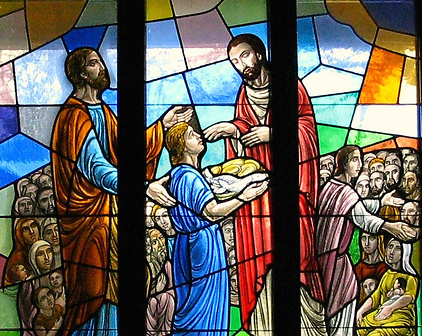
John 6:1-13 Feeding to 5000

What is your favourite miracles of Jesus? For me it is the feeding of the 5,000. Many people think and agree that if you assume that each man may have brought their wives and at least two children with them, the number of people may have been like 15,000. The people witnessed how Jesus performed miracles and people are excited to follow him everywhere he goes. Jesus wanted to get away from the crowd cross the river by boat with his disciples hoping that the people would stop following him and he would have time alone with the disciples. But the people would not give up, seeing that Jesus and his disciples rode the boat, the people started running along the shore through a rough woods and headed where the boat was going.

So when Jesus saw arrived some of the people were already there and had looked for a place to settle down. Instead of getting angry with the crowd, the Lord Jesus had compassion to the people and do something to take care of their needs. In this story, we will learn how the Lord Jesus did a miracle and we will learn what did the people do to experience that miracle in their lives.

Jesus wants our participation (5-6)


5.When Jesus looked up and saw a great crowd coming toward him, he said to Philip, "Where shall we buy bread for these people to eat?" 6. He asked this only to test him, for he already had in mind what he was going to do.
These verses clearly say that Jesus did not have to ask this question because “he already know what he was going to do.” He asked the question to test the faith of Philip and in effect the other disciples too. The Lord Jesus Christ does need anybody to tell him what to do. The only reason he asked this question is to know what the disciples are thinking and he wants them to share their thoughts and ideas. Jesus want his disciples to participate in helping to resolve the problem at the moment. 

Apparently, Philip is very smart because after looking at the crowd he knows right away how much money they need to feed all the people. He comes up with 200 denarii. In present times it is roughly equivalent to 4,000 US dollars or roughly 124,000 baht. And would not be enough to buy a bread enough that each person to get a little piece. Andrew, on the other hand, share his idea by getting Jesus’ attention that there is a little boy who is willing to share his food—five small loaf of bread and two small fish. He thinks it is impossible to feed all the people with this amount of food. I believe the important truth here is not only Jesus tests the disciples but also he wanted them to share ideas, do something to help with the problem. Jesus wants everyone to participate.

How do you eat an elephant? One bite at a time. We all know the saying, but we often fail to apply this lesson in our lives. If you view the elephant as one big goal that your whole life depends on, you’re setting yourself up for disappointment. Why not enjoy the bites along the way? If you ask somebody what goal they’re working on, what kind of answer do you think you’ll get? Assuming they even have goals, they’ll probably say they’re working on something really big, maybe even something that will make them feel like they’ve achieved their life purpose.1 Our church have big vision and big goal. We want to share Jesus Christ to many people as possible. We envision that our church will grow big and have many people come to worship our God. This goal is big. It is like an elephant. We can not eat it. It seems impossible. But if everyone of us will cooperate and will take a little bite one at a time. 

We will eventually accomplished the goal that God has set before us. The problem is only very few in the church like to cooperate. This is God’s challenge for us this morning. All of us should cooperate to accomplish our goal as a church.

Jesus Wants Our Contribution (6-9)

Another of his disciples, Andrew, Simon Peter's brother, spoke up, "Here is a boy with five small barley loaves and two small fish, but how far will they go among so many?"
In verse 6, it says that Andrew speaks up and says, "Here is a boy with five small barley loaves and two small fish, but how far will they go among so many?" Some Bible teachers think that this little boy is employed by the disciple to carry their food. But I believe, this little boy has committed himself to following Jesus wherever he goes that he make sure that he is totally prepared. 

The other people who follow Jesus and even the disciples never bother to bring their own food. I want you to take note the way John describes the situation. Here is a “little” boy with five “small” barley loaves and two “small” fish. I believe John is trying to show the greatness of our God that a miracle has come out using these small things. But, of course, these small things from little boy are what all Jesus need. He never asks us to have more education, more talent and more money in order to serve him and minister to others. All he wants is what we have right now. And as soon as he found out what is available in the crowd, Jesus performs a wonderful miracle. 

 There was a story of a little girl who stood outside the church crying. She could not get into the church to attend the Sunday School because the church was too small and there was no space for her. So the Pastor saw him and took her hand and found a place for her in the Sunday School class. The girl was so touched that night she went to bed praying and thinking of the children who have no place to worship. The Pastor told her that someday they would have a building big enough so that all the children can worship and attend Sunday School. Later the girl got sick and died. They found out that the little girl has a purse that contain 57 cents with a note saying that she was saving the money to help build a bigger church building. The 57 cents became the seed money that inspired many people to contribute to the fund that eventually built a 3,300 seating capacity of Temple Baptist Church in Philadelphia, USA. This story is being told to show what God can do with 57 cents. This is what God wants us to do, everyone can bring something to God. He teaches us that it is not the gift that is so important, it is the heart of the giver. 

In our church, people contribute different things. We need people who will be prayer warriors. We need musicians and singers to lead in worship. We need workers to clean and set up our church. Some contribute money, some contribute things that we can use in the church. If everyone of us will contribute to the ministry of the church, the Lord will do miracles in our church.

Jesus Wants Our Cooperation (10-13)

Jesus said, "Have the people sit down." There was plenty of grass in that place, and they sat down (about five thousand men were there). Jesus then took the loaves, gave thanks, and distributed to those who were seated as much as they wanted. He did the same with the fish. When they had all had enough to eat, he said to his disciples, "Gather the pieces that are left over. Let nothing be wasted." So they gathered them and filled twelve baskets with the pieces of the five barley loaves left over by those who had eaten. (John 6:10-13)
When Jesus learns that little food is available, he asked the disciples to make the people sit down. Just imagine 15,000 hungry people want to eat and food was so little, it is surprising that everyone including the children are cooperating with Jesus. We read how orderly and organise was the event in Mark 6: 39-44:
39 Then Jesus directed them to have all the people sit down in groups on the green grass. 40 So they sat down in groups of hundreds and fifties. 41 Taking the five loaves and the two fish and looking up to heaven, he gave thanks and broke the loaves. Then he gave them to his disciples to distribute to the people. He also divided the two fish among them all. 42 They all ate and were satisfied, 43 and the disciples picked up twelve basketfuls of broken pieces of bread and fish. 44 The number of the men who had eaten was five thousand.
In this passage we learn how every one including the children cooperate with the process. John MacArthur: "Godly, Biblical church growth results from every member of the body fully using his spiritual gift, in submission to the Holy Spirit and in cooperation with other believers.” When each one of us is willing to cooperate with the church’s ministry and activities, cooperate with our leaders and with each other, the Lord Jesus will perform a miracle though us and through our church.


Conclusion

Imagine yourself asking someone to be part of our church. “Do you want to be part of our church?” And imagine that the person will answer like this: “I want a church will accept me as I am.” “I want a church that will care for me.” “I want a church that where my needs are met.” “I want a church that makes me feel happy.” “I want a church that will feed me spiritually and make me grow.” We can answer that is our church… provided (if) that: “If you and other church members will accept others as they are.” “If you and other church members will care for one another.” “If you and other church members will make others feel happy.” “If you and other church members will feed and make help each other grow spiritually.” Miracles happen or at least great things happen when the people of God all participate, contribute and cooperate in what God desires to do through his people.

Saturday, August 09, 2014

We Are Never Alone

Ephesians 2:19-2:22
Brick in grass We live in an entertainment culture. People want to be entertained all the time. We want to watch movies, play games, do social media, listen to the music. We do want to feel good all the time and we easily get bored. Sometimes we think that people who comes to the church need to be entertained. So we want our worship service to be more appealing to the people so that they will come back again and again. However, we should keep in mind that attend worship not to be entertained or not to get something out of the service. If we come here for that reason then this is a selfish motive. We are here not to feel good or get something out of the church service but to give our worship to God. In Ephesians Chapter 2, the Apostle Paul reminds us that when we go to the church let us forget about ourself but think about God and the church. So let’s read our passage together: Consequently, you are no longer foreigners and aliens, but fellow citizens with God’s people and members of God’s household, built on the foundation of the apostles and prophets, with Christ Jesus himself as the chief cornerstone. In him the whole building is joined together and rises to become a holy temple in the Lord. And in him you too are being built together to become a dwelling in which God lives by his Spirit. - Ephesians 2:19-22 (NIV)
Many people think that being a Christian is all about their needs. They think it is all about me. Or it is about me and God. Being a Christian is about God, me and other Christians. As Christian we should think we are not alone because…

God has made us part of the new kingdom

…you are no longer foreigners and aliens, but fellow citizens with God’s people…(verse 19). Paul is mainly writing to the Gentile believers. In verse 12, he described how these Gentiles were excluded from citizenship in Israel and foreigners to the covenants of the promise. But the point he is making here is that it doesn’t really matter because they are now citizens of a new kingdom that is higher than the kingdom of Israel. For us who lives near the border, we know how important is citizenship. For those who are not citizens, we watch closely the changes to the immigration laws. As citizens, you have benefits that you enjoy. You have the right to travel wherever you want and to choose wherever you want to live and work. Your rights are also protected by your laws. You have benefits that we non-citizen will not enjoy. But you also have responsibilities to pay taxes (although some do not). You have the responsibility to follow the laws and obey your leaders. When we choose to be followers of Jesus Christ, we also become citizens of His kingdom. And that citizenship also comes with privileges and responsibilities. We get the privilege of being part of a body where we can be encouraged and where we can grow in our faith. We get the protection of our King – the Lord Jesus Christ. At the same time, we also have a responsibility to participate in the life of the body and submit to its leadership. We have a responsibility to give financially so that the church can do the ministry. We have the responsibility to minister to those who are in need. We have the responsibility to live a good Christian life. We have the responsibility to obey our leaders.

God has made us part of a new family

…members of God’s household… (verse 19) Again, Paul has already made reference to this aspect of our life in the church earlier in His letter. You’ll remember that at the beginning of chapter 1 Paul wrote that when God chose us He also adopted us into His family. As great as it is to be a citizen in God’s kingdom, it’s even better to be a part of His family. Look at how John described the greatness of being God’s children: How great is the love the Father has lavished on us, that we should be called children of God! And that is what we are! 1 John 3:1 (NIV) I was reflecting this week on all the benefits that I enjoy by being part of a family here on earth. Nobody love us like our own family. Our family will protect us if somebody will try to do us harm. Our family will lift us up when we fall. We may have arguments with our parents, brothers and sisters but the family relationship will never be broken. A family is also the place where we experience the deepest intimacy here on this earth. The relationships between husband and wife, parents and children, brothers and sisters provide a far greater opportunity for intimacy than any other relationships we have. Our church is our family in Christ. We should love each one like a true family. We have responsibility to one another. God has chosen us this family to help us grow in Christ. God brought us to this church so that he can use us that we can help each other to be strong in our faith. This is the place where we can develop deep intimate relationships more than any other people outside the church family. Our common bond is our Lord Jesus Christ. He is the strongest force that connect us with other Christians. God does not create spiritual orphans. It is never His intent that His children would be estranged from His family. So why would any Christian want to try to live out his or her faith apart from the family that God has given to them?

God has made us part of a new building

The third imagery that Paul uses to describe our place in the church is a building. The church is not the building but it is like a building. It is built on the foundation of the Word of God—the Bible. …built on the foundation of the apostles and prophets… When Paul mentions the apostle and prophets, he is referring to those who received and proclaimed the word of God. The preaching and eventually the writings of the apostles and the prophets is passed on to us. Joined together in Christ …with Christ Jesus himself as the chief cornerstone. In him the whole building is joined together and rises to become a holy temple in the Lord. And in him you too are being built together to become a dwelling… When Paul talks about Jesus being the cornerstone he is thinking of the cornerstone that was used in Jerusalem Temple. It was a stone as big as a Green Bus and it weighs about 600,000 kilos. The cornerstone was the most important stone in the building. It marked the point in which the rest of the building would be constructed and in a sense it held the whole building together. But Jesus is more than just the cornerstone. He is the means by which all of the individual stones are being joined together in this building. A single brick is worth nothing, in fact, it is not much to look at. But when we have thousand of bricks and put them together we can build a beautiful house. The bricks do not put themselves together. A workman had to prepare a plan, make it square and they have to be put on top of one another and bond them together with a cement. This is like what Jesus does when he builds the church. He takes a lot of bricks that are not really good and worth nothing on their own. He first them together with other blocks and bonds them together with a cement. Although Jesus is concerned with the each brick, his overall purpose is to create a building that will give glory to his name. On our own separate from the church, we cannot do anything. But if we are bonded to Jesus Christ and to each other. We can do great things for God and we can win more people to Jesus. Indwelled by the Holy Spirit …in which God lives by his Spirit. Most of us are probably familiar with this passage that describes how God’s Holy Spirit lives within us: Don’t you know that you yourselves are God’s temple and that God’s Spirit lives in you? 1 Corinthians 3:16 (NIV) At the moment we received Jesus Christ, the Holy Spirit comes to live within us. And we all become the temple of God. Here the Apostle Paul is saying that the Holy Spirit dwells within all the believers but there is only one temple. All of us who believed in Jesus Christ are joined together to become one spiritual temple where God’s spirit dwell. God does not want Christian to be away from the church. Every follower of Jesus has been designed to be joined together with other believers into beautiful spiritual temple called the church in which God lives and works. This is the challenge for us. God wants us to stay and minister in this church. Otherwise, we will not be here. Those who are not here or who went to other church maybe does not belong here. But we are here and God called us to be here. There is no perfect church and no perfect pastor or church members. But Jesus wants everyone of us to be part of this church. A certain writer said: If we consider ourselves followers of Christ. We need to know this. The church is not here for us. We are here for the church. And the church is here for the world. Jesus did not die on the cross so that we can choose a church that make us happy. He died to give us abundant life, bring that life to the church and to share that life to the lost world.

Friday, June 27, 2014

Upgraded Commandment

John 13:34-35 Iphone5 store australia reuters People get excited when something new comes out. I can tell that it is true with iPhones. When the first generation iPhone came out, everybody wanted to have one. Now it iPhone 5c had been out for over a year and Apple is already announced the coming of iPhone 6. Many people still insanely excited about having the latest iPhone. In John 13:34-35, Jesus in his darkest hours, anticipating his suffering and a violent death on the cross told about his love and his coming death on the cross. I bet the disciples were expecting something else from Jesus than giving them a new commandment. “I give you a new commandment - to love one another. Just as I have loved you, you also are to love one another. Everyone will know by this that you are my disciples - if you have love for one another.” It is time for the disciples to get excited because Jesus was giving them a new commandment. We are supposed to get excited with this new love commandment from the Lord. What makes this commandment new? Isn’t the command to love is as old as the Old Testament? Here we will look at the reasons what make this commandment new and different from other love commandment.

From loving our neighbours to loving one another

A new commandment I give to you, that you love one another: just as I have loved you, you also are to love one another. The command to love is not new. Jesus had already taught that the whole Law of Moses was summed up in two great commandments in Mark 12:29-31 And one of the scribes came up and heard them disputing with one another, and seeing that he answered them well, asked him, "Which commandment is the most important of all?" Jesus answered, "The most important is, ’Hear, O Israel: The Lord our God, the Lord is one. And you shall love the Lord your God with all your heart and with all your soul and with all your mind and with all your strength.’ The second is this: ’You shall love your neighbor as yourself.’ There is no other commandment greater than these.” In John 13 the focus is upon the community of believers that Jesus will establish before he leaves. He knows that in order for the community to be strong and successful it should have a guiding principle. In order for Christianity to grow big they should follow the new commandment to love one another. It is true with the church. During the early years of Christianity, the Christians have always had tremendous impact on the people around them. They said that Christians love each other even before they know each other.” Is not just about loving our neighbors as yourself but we should love one another. It means loving other Christians and our church mates more than we love our neighbors and ourselves. We should not only love one another but we also should love like Jesus loved.

From like loving ourselves to loving like Jesus

A new commandment I give to you, that you love one another just as I have loved you; you also are to love one another. (ESV) The love that Jesus is calling for is not about not hating one another. It is not just about being patient with one another. This command is about being an active, self-sacrificial love just like Jesus loved the people. Jesus exemplified this love when he declared to the disciples that greater love has no one than this, that someone lay down his life for his friends. This is the kind of love that He wanted us to demonstrate for our brothers and sisters in our church. How do we show our love to one another? We may not be able to love like Jesus but we can at least show our love to our brothers and sisters in Christ by praying that God will bless them, by doing good for them and by overlooking their faults and by forgiving their sins. On our own, it is impossible to love one another like Jesus loved us but we should ask the Holy Spirit to empower us to love like him.

Conclusion

By this all people will know that you are my disciples, if you have love for one another." This love that Jesus mentioned is new in three ways: (1) There is a new focus. We are still to love our neighbor, but now this love is directed toward “one another. (2) We are no longer to love others like we love ourselves but we love just like Jesus loved. (3) This love makes the world realizes that Jesus is real and that we are his followers.[1] Love enables “all people” to recognize we accept Jesus. Here is a strong testimony to the world. All people will know we are Jesus’ disciples by our love. Christians will never be known by the beautiful building where we worship, they will not be known by what we hate, we will not be known for what we strongly believed (although that is very important), we will not be known by how good our music team is. All people will know that we are Christian if we love one another. If we love like Jesus loved us. Photo from NDTV Gadgets