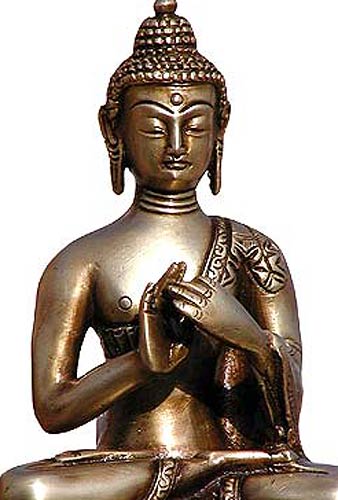
Our internet service provider had been down for a while. So I missed reading my favorite blogs for days. Anyways, it's getting colder here everyday. But I enjoyed the coolness of the night, sipping coffee while having a theological conversation with my Burmese Pastor. We talked a lot about the problem of the different tribal churches here and the difficulties of communicating the gospel to the Buddhists both in Thailand and Myanmar. It dawned on me that my knowledge about a Buddhist's perception of the world and of the deity is so little. I still have to learn a lot. If I want to make the gospel clear to them I have to know how their minds works. My Pastor is trying to help by presenting me theological papers written by his professor in the seminary. As he knows I am running blog, he ask me if I can post it here. And I gladly oblige.
The following thoughts are from his good professor a Burmese theologian named Professor U Khin Maun Din. This section deals with the problem of Burmese Christians Theology with its encounter with Theravada Buddhism. This part deals with the conflicts on the concept of God between Christianity and Buddhism. The next post will deal with the problem of Christology.
Buddhism is considered to be an atheistic religion or at best a non-theistic faith by many Christian theologians and religious philosophers. It is because Buddhism denies the existence of God as personal being or a creator. This personalistic idea of God is rejected by the Buddha because it could not explain the vexing problem of evil. But the Buddha does not deny the existence of what can be philosophically described as “the Transcendence” or “the Ultimate Reality.” If affirmation of the existence of a Transcendental Reality is what we meant by theism, then Buddhism is profoundly theistic. This raises a big problem for traditional Christian theology that insists that God is to be understood as Personal Being. However, process theologians’ understanding of God as becoming rather than being. Here process theologians give way to a more living, dynamic and changing conception of God rather than the traditional view of God as complete, perfect and static. Some of them agree with Paul Tillich in describing God as “the Ground of our Being.” This impersonal representation of God is considered by its critics as closer to Buddhism than Christianity. However, this paved the way to the possibility that the Christian idea of God can be made understandable for Buddhism and other Asian transcendental religions.
However, in the view of the Theravada Buddhists these understanding of the deity are still relative ways of understanding the Transcendence. For Buddhists the best way to describe the Ultimate Reality is not to describe it all because the Absolute can never be described by relative human terms. This theology is not peculiar to Buddhism alone. The Taoists of ancient China also held a similar view of Reality. They say that “the Tao is the name of the nameless one.”
The point here is: can we as Christians insist to speak about God as a person or a personal being in an absolute sense. Is it not closer to the truth to speak of God as a person as well as not-a-person; that God is a Being as well as a Becoming, that God exists and also does not exist?
This way of understanding the theos has been referred as the “the Yin-Yang way of Thinking.” It is the Both/And method of doing theology and being advocated by Asian theologians to be more progressive as opposed to Either/Or method used by classical Christian theology in formulating theology. The Either/Or way of thinking in the West not only promoted but shaped the absolute dogma of God. The God of dogma is not God at all. The God who is absolutized by human words is less than God of Christianity.
From such perspective the “silence” of the Buddha becomes pregnant with meaning. To the Buddha the relatively best way of describing the true nature of the Transcendence is not to describe it at all. This methodology can be discern as common in major oriental philosophies like Taoism of ancient China, the Jains of India among others. The oriental refusal to predicate the Transcendence with the western philosophical categories should be interpreted as the denial of the “existence” of “God” as a “Personal Being or “a Creator” is not a total rejection of the indescribable, transcendental theos.
What can we learn from this Oriental Methodology should Christian theology continue to keep on referring to God as a person in an absolute sense? Is it against the Bible to speak of God is a Person, as well as-not-a Person, that God is a Father as well as not-a-Father, that God is a Creator as well as not a Creator, that God is a Thou as well as not a Thou?
How must we interpret God’s answer to Moses: “I am that I am?” Is the word “I” to be understood as referring to a Self, a Soul, an Ego, an Atman, a Spirit or even a Geist as used by Hegel? If that scripture text means: “I will be to you what I will be to you,” as it is not interpreted today, then is it not the case that the answer is to be understood functionally and not ontologically? If that is the case, then metaphysically speaking, such an oriental way of understanding the Theos can be more comprehensive and sometimes even more faithful to the Gospel than most dogmas attached to the traditional Christian doctrine of God.
I can understand the difficulty of Christians in Burma to conceive God in non-personal terms. We are being so metaphysically conditioned by the traditional theology that the very idea of a non-personal God becomes totally incomprehensible to us. But this means that we must also be sympathetic to the Buddhists for whom the very idea of God as Personal Being is incomprehensible. If Christian theology in Burma and in Thailand still persists in speaking of God only and absolutely as a Person then the Christian God will be reduced to the level of a Nat or a Brahma.

.jpg)

