Christians living in a predominant Buddhist country struggle on how they can speak about their faith that makes sense to their neighbors. On the surface, it seems that Buddhism and Christianity have very little in common. We have no choice but to begin on a common pointm, start from the subject you know they are famiilar with. Although sometimes, it will surprise you that they know little about the philosophy or theory of their religion. It is because their religion is not much of a matter of sophisticated theology that drives them to their religious practices. Even Buddhist thinkers would reject the rituals and some bizarre practices of a folk Buddhists but the folks do it anyway because they think that is what their religion demands from them and it makes them feel better.
My point here is it is good to teach them about their own belief and start a conversation. It is important to understand religious experiences express in the practices and learn as much as possible the theory behind the practice. This is the same with Christianity. There are underlying theories in our every religious experience and practice. It is sad enough that many Christians really do not understand the theory or the theology behind our practices such as worship, communion, baptism among others. Nonetheless, I appreciate evangelical Christianity emphasis on teaching and learning as part of being a church member. At least, through this we understand our doctrines that somehow explain some of our practice.
Dialogue between Christianity and Buddhist is possible only if at least one of the dialogue partners have knowledge of both faiths. And I believe the burden of learning other religion is on our shoulders to make our faith understandable. I admit, this is not easy but only through such interweaving of theory and practice, experience and reflection, will be able to put the dialogue between Buddhists and Christians about the message of the Buddha and the message of Christ. Hopefully, there are more similarities than differences.
Hans Kung names some of the similarities of the two religions. I have to depend on secondary sources by Hermann Haring on his book about Hans Kung because I don't have a copy of Kung's
Christianity and the World Religions (I hope I can buy a copy in the future). Nevertheless, here Kung points out the similarity between the Christ and the Buddha. Both Christ and Buddha appear as teachers, proclaim good news, want to liberate human beings from their desires and their self-centeredness and point out a middle way, of selflessness, of concern for fellow men and women. That makes the difference all the more significant. Jesus was not solitary, but a master in an alternate community; no break can be established in hi life. The differences can be clarified most plainly by means of the distinction between a prophetic and mystical spirit.
The Buddha Gautama is a harmoniously self-contained peaceful, enlightened guide, inspired by the mystical spirit. Sent by no one, he demands renunciation of the will to life for the sake of redemption from suffering in nirvana. He calls for turning inwards, away from the world inward, for methodical meditation through the stage of absorption, and so finally to enlightenment. Thus he shows calm fellow feeling, with no personal involvement, for every sentient creature, man or animal; a universal sympathy and peaceful benevolence.
Jesus Christ, however, is a passionately involved emissary and guide, inspired by the prophetic spirit and, for many, even his own lifetime, the Anointed One (“Messiah”,”Christ”). He calls men and women to conversion for the sake of redemption from guilt and all evil in the kingdom of God. Instead of demanding a renunciation of the will, he appeals directly to the human will, which he bids orientate itself on God's will, itself aimed entirely at the comprehensive welfare, the salvation, of humankind. Thus he proclaims a personally concerned love, which includes all the suffering, the oppressed, the sick, the guilty and even opponents and enemies: a universal love and active charity.
These are some of the similarities. Other such commonalities and differences as well will be dealt with in the future posts.
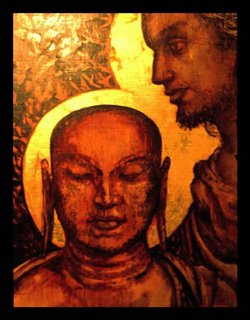
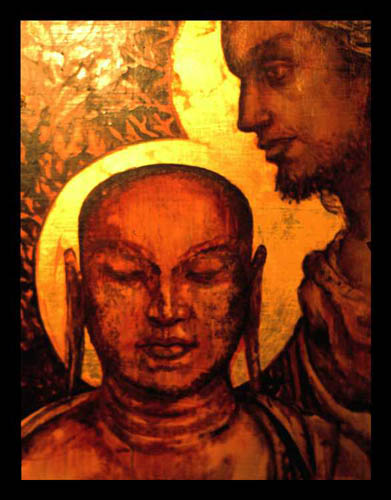
About the image: The image is taken from MattStone Blog
created by Ruth Jones.
 One morning as we were getting ready for our morning worship service, I looked out of the window and felt the mild wind of the morning air, made sweet and cool by a strong pouring rain. Our Burmese Pastor walked in and stood by my side and said, “this year seems to be unusual, the rain came early and rains are the heaviest I've seen so far since we moved here in Mae Sai.”
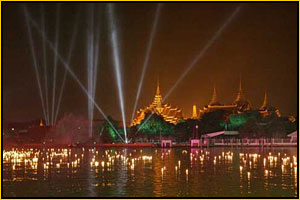
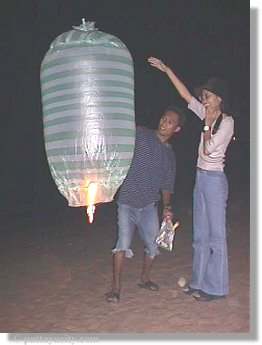
 Our Burmese Pastor continued... “however, today, this rain will be the last rain for this year.” I looked at the calendar that hanged beside the window and asked him with a hint of unbelief in my voice, “is that so? We are just on the second week of October.” And he answered, “I'm pretty sure that this will the last rain. Then after a week, the Buddhists both Burmese and Thais will go to the river to float their little boats with candles, joss sticks, flowers, money and sometimes food to offer thanksgiving to the goddess of river for providing the rain for an assurance of good harvest this year. In that boat, they will also cast the bad lucks they had and the wrongs they did for this year and feel good looking forward to the coming year.” He looked at me as if saying, you have to believe me and I give him a very slight nod.

.jpg)


