Sunday, December 28, 2008

Happy New Year

Last night I took the courage to upgrade my Mac OS X from Panther 10.3.9 to Tiger 10.4.11. The happy results are I was able to install Missingsync 4.04 and the latest version of Journler. Missingsync makes it possible for me to synchronized my Mac with my (actually borrowed) Windows Mobile Toshiba e380. Journler on the other hand makes it possible for me to write my journal and other stuff. This enables me to to post offline which is the usual situation I am in right now.

This year, I need to spend a lot of times writing my paper. Hopefully, I can also blog regularly.

I preached in the church this morning and upon seeing that there were more locals than the internationals who attended the worship service, I requested Isaac (our official translator in the Jubilee Bible School) to translate for me. It has been a while since I preached with translator and I still found it uncomfortable.

Anyways, last night as I was preparing the sermon and I was looking for a good illustration to the introduction. I found this prayer from e-sword illustration tools.

May this be our prayer for the new year as well.

Lord, I confess before You that:

I have had longings and nudges from You which I did not translate into action.

I have made decisions without consulting You, then have blamed You when things went wrong.

I have said that I trusted You, yet have not turned my affairs over to You.
I have been greedy for present delights and pleasures, unwilling to wait for those joys which time and discipline alone can give.

I have often sought the easy way and have consistently drawn back from the road that is hard.

I have been fond of giving myself to dreams of which I am going to do sometime, yet have been so slow in getting started to do them.

Forgive me for all the intentions that were born and somehow never lived.

And now I claim Your promise to change me. Do for me what I cannot do for myself. Lead me into a new tomorrow with a new spirit. Cleanse my heart; create within me new attitudes and new ideas, as only You can. Amen.


Tuesday, December 02, 2008

Friday, November 28, 2008

The van broke down

The van spewed engine oil on the road on my way to the church when I was bringing the people to the church last Sunday. I wasn't aware of it until I picked up some church members on our way and told me that the van was spilling a lot of oil on the road.

I really felt bad about it. First because I still had to bring my family yet to the church and second the spilled oil was fatal for hundreds of motorcycles that pass on the road. I stopped on the red light in a turn and I left a pool of spilled oil there. The police found out about it and they put sand on it.

Maybe ten months ago, I noticed the leak from the engine and asked the mechanic to do something about it. He put new gaskets and oil seal, but after a week the oil started to leak again. I mentioned it to him and he started to reason out about the cylinder being loose. Although I think that a loose piston would not cause oil leaks, I didn't argue. It was hard argue with someone you don't understand and can't understand you. So when I called him last Sunday, he was kinda apologetic for doing a bad job.

Anyways, the van broke and the good side of it is I have a break doing the bus run. And it feels good. When I volunteer to do the bus run for the church's school and the nursery I thought it would be a relaxing drive and therapeutic at times. But the school grew and the number of students doubled within six months. This results to an unexpectedly long drive that took two hours in the morning and two hours in the afternoon. It becomes really a serious difficult work. Not that I am complaining.

The van broke down, but it feels good. I almost praying that the repair will take longer. But again, I have to think about the children being driven dangerously in a motorcycle to the school.

The blogger's word verification and typing the characters you see in the picture to post this still annoys me.

Tuesday, November 18, 2008

So little time, so much to do

I'm falling behind with my blogging. The main reason is we have been very busy in the training center. We had hosted a week of church planting seminar and another week of Condensed World Mission Course. These activities did not only involved teaching but lots of errands and food preparations. I hope to catch up with blogging soon. Also I can't post offline using MarsEdit because of blogger's word verification. This is very annoying.

Tuesday, October 14, 2008

Reading biblical narratives

Big percentage of the Biblical materials is narrative. Narrative is a literary form characterized by sequential action involving plot, setting and characters. The meaning of the narrative derives primarily from the actions of its characters. Rather than telling us how to live or how not live, stories teach us the same through the actions of the characters.

The purpose of these stories is theological. God uses them to teach us theology. The Bible gives us examples how to teach profound truth through stories and I believe we can use it to teach our people too.

Why did God choose narrative literature to communicate theological truth to us? Why didn't he communicate everything through essays or law? Think for a moment about these questions. Here Duvall and Hays list some of the advantages and disadvantages of using narrative to communicate theological truth.

Advantages of Using Narrative to Communicate Theological Truth
  1. Narratives are interesting, both to children and to adults.
  2. Narratives pull us out into the action of the story.
  3. Narratives usually depicts real life and are thus easy to relate to. We find ourselves asking what we would have done in that situation.
  4. Narratives are easy to remember.
  5. Narratives portray the ambiguities and complexities of life.
  6. God can include himself as one of the characters in the narrative. Thus he can teach us about himself by what he says and does in specific contexts.
  7. Narratives are holistic; we see characters struggle, but we also often see resolution of their struggles. We see the entire character.
  8. Narratives relates short incidents and events to a bigger overall story.
Disadvantages of Using Narrative to Communicate Theological Truth
  1. The meaning of the narrative can be subtle or ambiguous and not clearly stated; the casual reader may miss it altogether.
  2. The reader may get enthralled with the narrative as a story and miss its meaning.
  3. The reader may assume that since literature is narrative, it deals only with history and not theology.
  4. The reader may read too much theology in the narrative (allegorizing).
Here the pros outweigh the cons. The authors of the Bible thought the same. I agree with Duvall and Hays that God chose to use the literary device known as narrative as major way to communicate his big story precisely because the biblical narratives engage us in such a powerful way. They challenge us, interest us, rebuke, puzzle us, and entertain us. They stick in our memory. They make us think and reflect. They involve us emotionally as well as intellectually. They teach us about God and his plan for his people. They teach us about all kinds of people--good ones and bad ones, faithful, obedient ones and mule-headed, disobedient ones. They teach us about life in all its complexities and ambiguities.

Duvall & Hays, Grasping the God’s Word: A Hands-On Approach to Reading and Interpreting, and Applying the Bible, pp. 288-294

Sunday, October 12, 2008

Interpreting Revelation

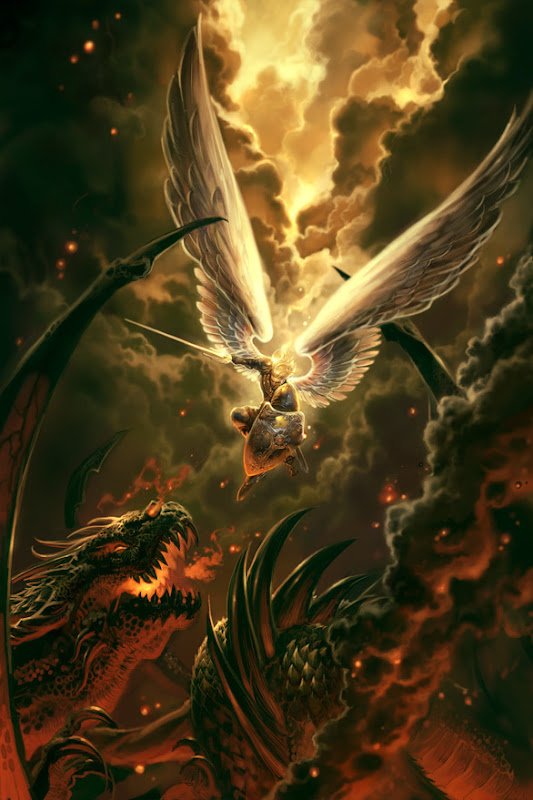
to_chain_the_beast.jpgReading Duvall & Hays' Grasping God's Word has been a fascinating experience for me. The book provides me with the latest method in biblical studies. They are reinforcing the traditional methods that scholars find to be still valid. They also present some of the more effective approach to studying the different literary genres of the books of the Bible.

Here Duvall and Hays suggest specific principles in interpreting Revelation. The following are mostly direct quotes from their book:

Read Revelation with humility. We should resist "Revelation-made easy" approaches. Revelation is not easy. People who must satisfy their curiosity or people who are unwilling to live with any uncertainty are those most likely to read into Revelation things that are not there. Beware of interpreters who appear to have all the answers to even the smallest questions. "Experts who claim absolute knowledge about every minute detail of Revelation should be held in suspicion. Reading with a humble mind means that we are willing to admit that our interpretation could be wrong and to change our view when biblical evidence points in a different direction.

Try to discover the message to the original readers. Discovering the message to the original audience is top priority with any book of the Bible, but especially with this one. When it comes to reading Revelation, the tendency is to ignore the first Christians and jump directly to God's message to us. Some people use today's newspapers as the key to interpreting Revelation. But as Keener notes, this approach does not fit well with a high view of Scripture.

The best place to begin is with the question: What was John trying to communicate to his audience?" If our interpretation makes no sense for original readers, we have probably missed the meaning of the passage. Fee and Stuart remind us of how important it is to discover the message to the original audience: As with the Epistles, the primary meaning of the Revelation is what John intended it to mean, which in turn must also have been something his readers could have understood it to mean.

Don't try to discover a strict chronological map of the future events. Don't look for Revelation to progress in a neat linear fashion. The book is filled prophetic-apocalyptic visions that serve to make a dramatic impact on the reader than to present a precise chronological sequence of future events.

Take Revelation seriously, but don't always take it literally. Some who say we should interpret Scripture symbolically do so in order to deny the reality of scriptural truth or a historical event. When they say that something is figurative or symbolic, they mean that it is not real or that it never happened. That is not the intention of this book. We insist that picture language with its symbols, images, and figures is capable of conveying literal truth and describing literal events. Picture language is just another language vehicle, another way of communicating reality. In our way of thinking, Revelation uses picture language to emphasize historical reality rather than to deny or diminish it.

Pay attention when John identifies an image.
When John himself provides a clue to the interpretation of an image, we should take notice. In other words, we should pay close attention when John identifies or defines the images for his readers. We can not assume that images like lampstands would always refer to the churches. John may use the same image to refer to different things.

Look to the Old Testament and historical context when interpreting images and symbols. Revelation uses language at several different levels:

Text level: words written on the page
Vision level: the picture that the words paint
Referent level: what the vision refers to in real life

One of the most difficult aspects of reading Revelation is knowing what the images and symbols refer to. Even when we understand what is happening at the text and vision levels, we may not know what Revelation is saying, but we are often not sure what it is talking about.

The two places to go for answers are to the first-century historical context. Revelation uses much of Old Testament imagery. The book is filled with echoes and allusions to the Old Testament. In fact, Revelation contains more Old Testament references than any other New Testament book, with the Old Testament appearing in almost 70 percent of Revelation's verses. Psalms, Isaiah, Daniel, and Ezekiel make the most important contribution to Revelation.

Above all, focus on the main idea and don't press all the details. This last interpretive guideline is perhaps the most important of all. With most literary genres in the Bible, we begin with the details and build our way toward an understanding of the whole. With revelation, however, we should start with the big picture and work toward an understanding of the details. As we seek to identify the theological principles, we should focus on the main ideas.

The details of any particular section will heighten the impact on the reader but will not change the main idea. Resist the temptation to focus on the details so that you miss the main idea. Don't let the main point of each section or vision fade from view. As has been said, when reading Revelation, the main thing is to make the main thing the main thing.

*The image is from Meta-Logic Cafe'.

Duvall & Hays, Grasping the God’s Word: A Hands-On Approach to Reading and Interpreting, and Applying the Bible, pp. 288-294